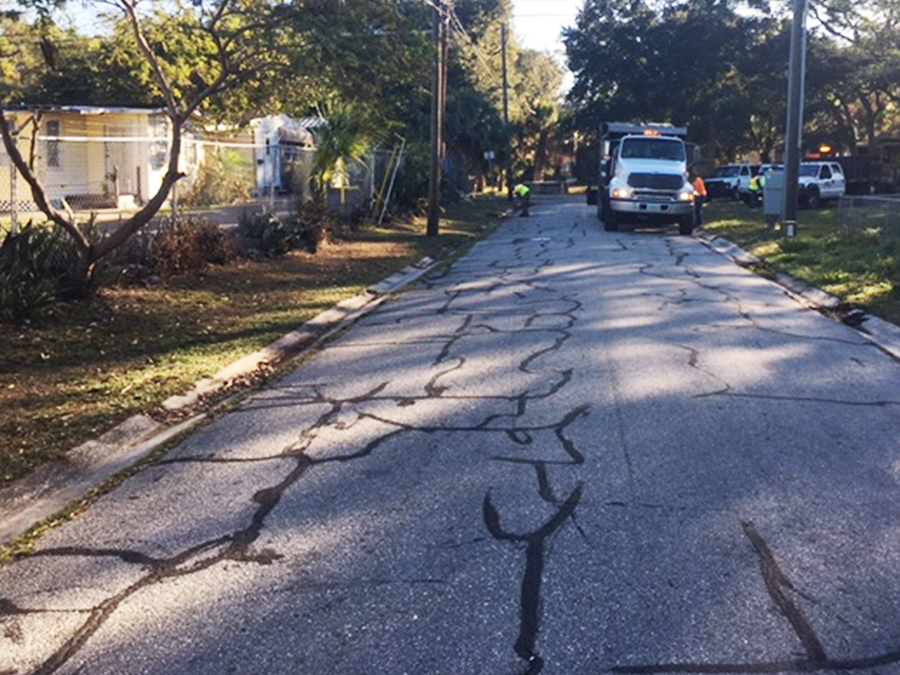
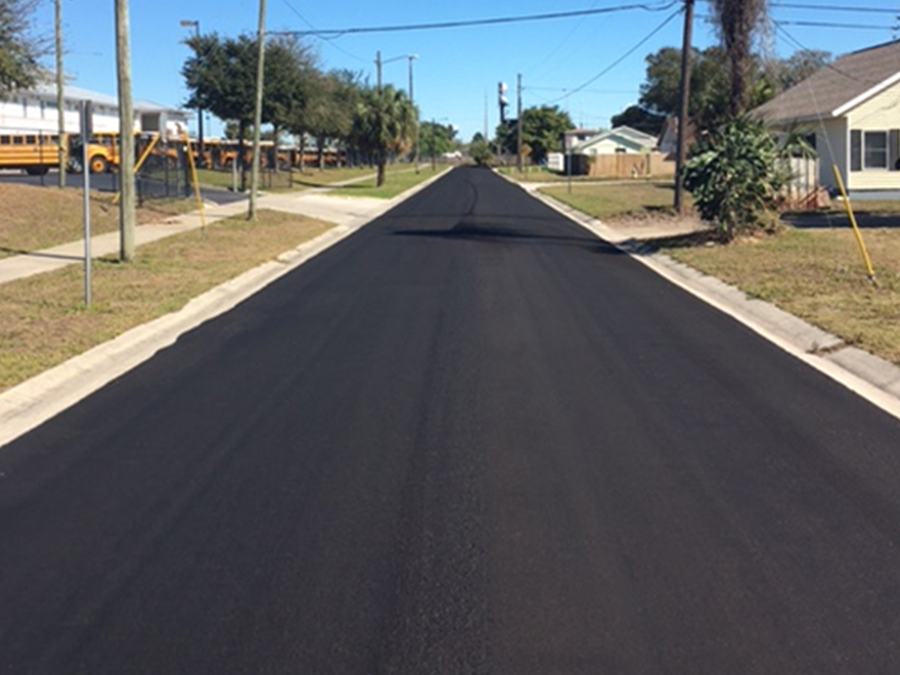
Background: The pavement on the rest area along I-20 (near Mile Marker 85) in Tuscaloosa, Alabama, was oxidized and raveling. In addition to constant passenger vehicle traffic, the area was wrought with distresses caused by the heavily- loaded semi-trucks frequently turning into and throughout the area and parking for extended periods of time. In 2016, ALDOT’s Mark Waites asked Ergon A&E reps Matt Jeffers and Anthony Quattlebaum if there was a cost-effective, long-term solution to this issue. They suggested a cape seal using Ergon’s eScrub rejuvenating scrub seal and eFlex premium micro surfacing. Cape seals involve the combination of two or more treatments that allow for increased protection of underlying road layers by preventing water intrusion and providing a durable wearing course. This would be the first cape seal treatment applied in a rest area in Alabama.
Application Highlights: In August 2019, funds were allotted for the cape seal project to begin as part of a larger project on I-20. Charles E. Watts was selected as the scrub seal contractor and Whitaker Contracting was awarded the bid for the micro surfacing application. The rest area was closed to traffic during application.
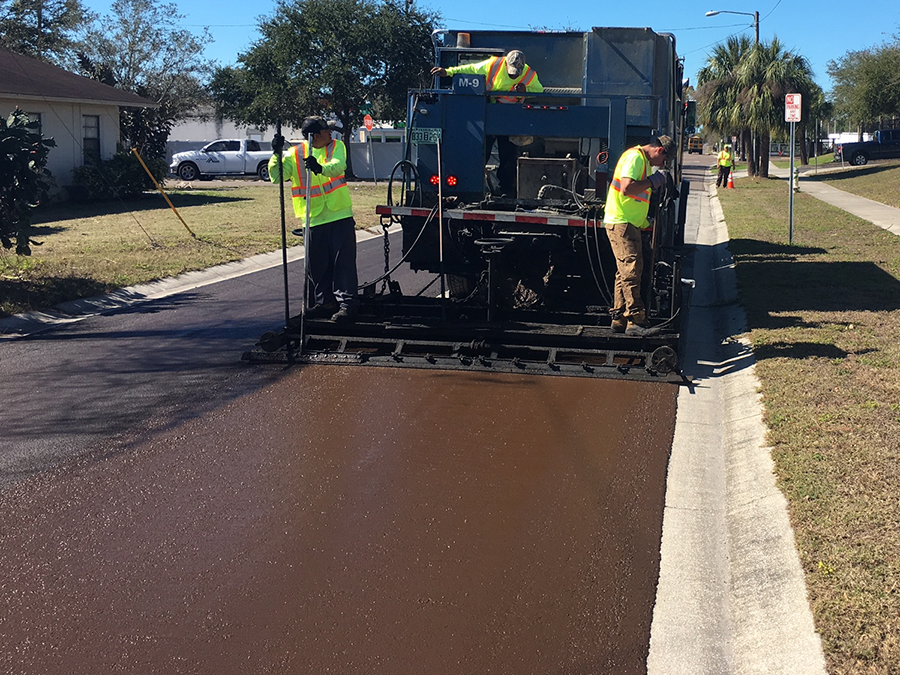
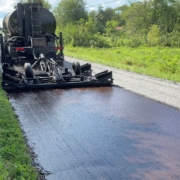
eScrub was applied as the first layer of the cape seal. eScrub’s apply-and-scrub method forces emulsion deep into voids and cracks for a long lasting seal while its rejuvenating agent revitalizes the pavement. Next came the application of the highly polymerized eFlex for a tough wearing surface able to withstand heavy passenger and utility truck traffic, resulting in less scuffing, power steering burns and raveling. Together, these treatments are expected to extend pavement life by 8 – 10 years.
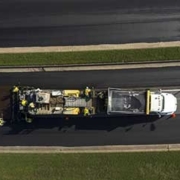
eScrub was applied at a shot rate of 0.30 gallons per square yard and covered with size 89 aggregate, which was applied at an average of 19 pounds per square yard. Traffic was returned to the pavement within a few hours following this application. Nearly two weeks later, eFlex was applied over the scrub seal – to finalize the cape seal process – at 17 pounds per square yard (single lift). While the surface would accept a typical return to traffic within one hour, Whitaker Contracting decided to wait 12 hours before turning traffic onto the pavement to ensure it was ready to withstand the heavy trucks rolling in.
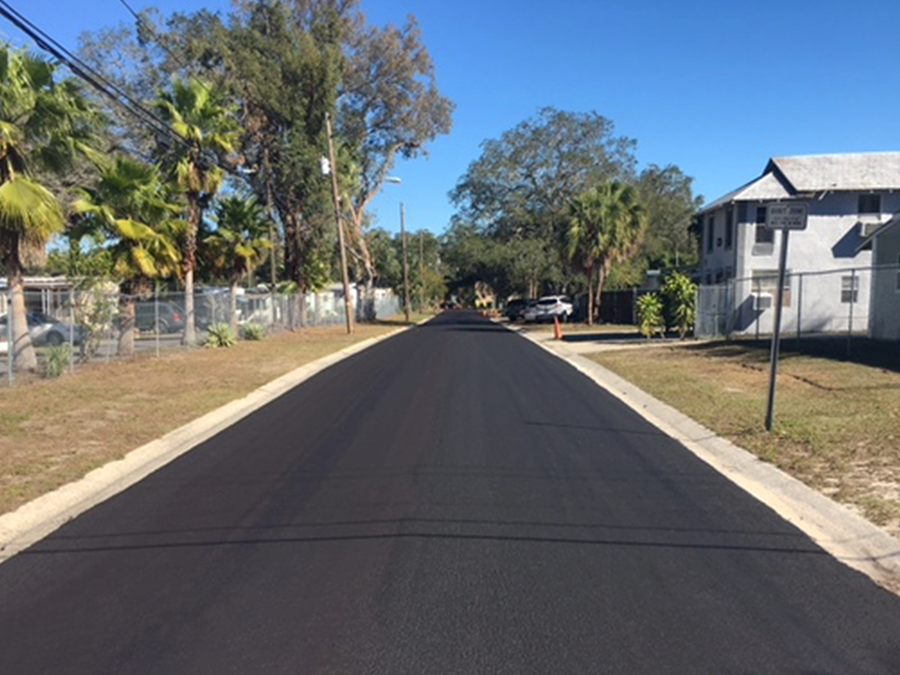
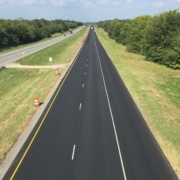
Results: ALDOT, Contractors and EAE were pleased with the initial results, noting excellent color and no power steering burns, raveling, pavement deformation or cracking five months after application. ALDOT will continue to monitor the area over the next few years to get a full scope of the impact of cape seals in highly trafficked rest areas.
Cost Savings: At approximately $5 per square yard for eScrub and eFlex combined, ALDOT achieved significant cost savings, spending less than they would had they applied the only other alternative – a mill and fill at $8 – $12 per square yard.
Long-Term Strategy: Monitor the area at 1, 5, 8 and 10 years for a more complete picture of the impact of cape seal treatments in highly trafficked rest areas.
https://ergonasphalt.com/wp-content/uploads/2025/12/cape_seal_solution-scaled.jpeg19202560Rick Potratz/wp-content/uploads/2024/08/asphaltlogo2.pngRick Potratz2020-06-09 19:28:592026-08-21 08:50:35Cape Seal in Tuscaloosa, Alabama Rest Area
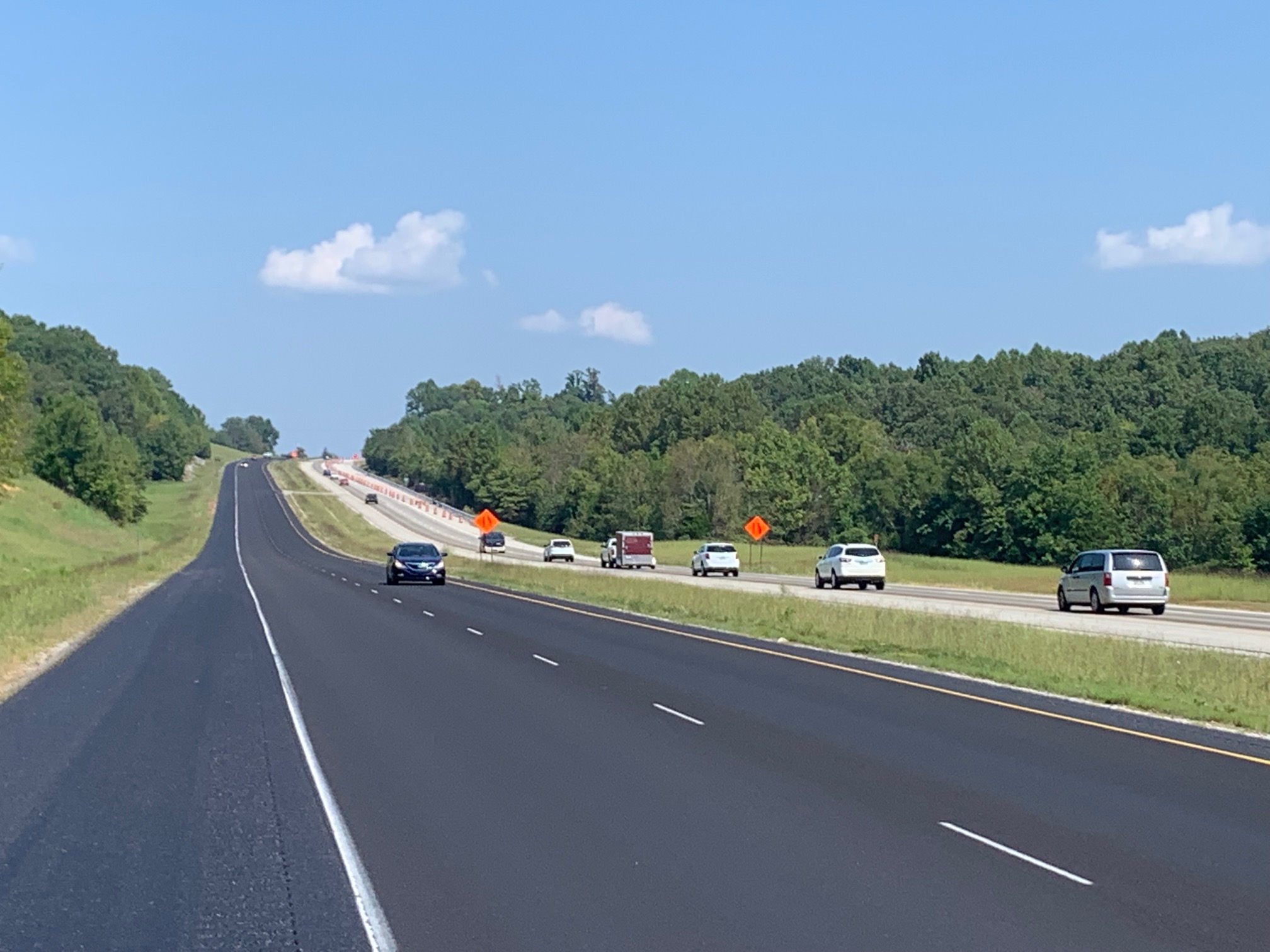
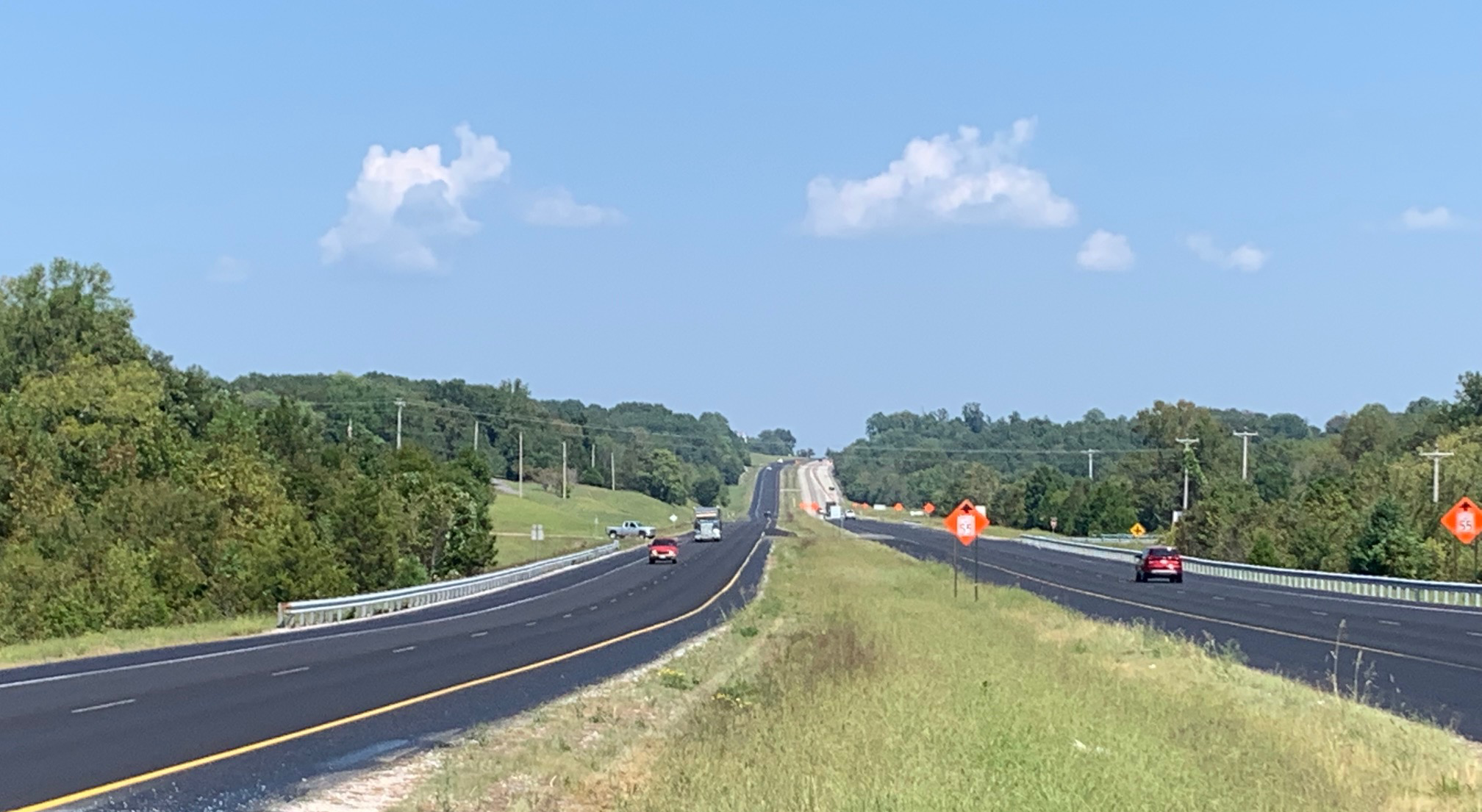
Cape seals combine the benefits of two treatments for increased protection of underlying road layers by preventing water intrusion and providing a durable wearing course.
Project Details In preparation for the cape seal project, the City, along with the selected contractor, Missouri Petroleum, proactively communicated with impacted citizens and businesses using door hangers and social media, as well as the official City of Malvern webpage. To ensure public safety in and around work areas, Missouri Petroleum also provided wooden road barriers and road closure signs.
Application Highlights
In 2020, the City was approved for a bond issue to meet the necessary investment to address isolated structural distresses before the cape seal project. In 2021, Missouri Petroleum applied a rejuvenating scrub seal using eScrub as the first layer of the cape seal to 12.3 miles of road.
During this process, eScrub, a polymer modified and rejuvenated asphalt binder, was applied over existing pavement at a shot rate of 0.30 gallons per square yard and then covered with a layer of Class 4 aggregate that was rolled and embedded into the modified binder. The use of a scrub broom forces the binder deep into the cracks, repairing mass cracking and revitalizing the pavement by returning asphaltenes into the original asphalt. The scrub seal was followed by the application of highly polymerized eFlex micro surfacing at 25 pounds per square yard. eFlex works to inhibit oxidation and provides an extremely durable wearing surface. Together, these treatments are expected to provide a minimum of 7-10 years of life extension for the treated streets.
The performance of treatments applied in 2021 and the publics positive response thereafter led to the City cape sealing another 17.7 miles of network streets in 2022.
Results
The City of Malvern and the driving public are enjoying the finished result, including the look of freshly laid pavement and enhanced durability. The applied combination of rejuvenating scrub seal and high-polymer micro surfacing has addressed the serious distresses our streets were experiencing and has held up well under snowplowing, said Jacob Wright, City of Malvern Street Department Superintendent. The treatment has greatly improved the overall ride quality and has provided a surface capable of being maintained for the next 10 years. The City is extremely pleased with the finished product and now has another tool in its pavement maintenance toolbox.
Cost Savings
The City was able to save millions of tax dollars using cape seal as opposed to the traditional mill-and-fill approach. In addition, by sealing the high level of cracking, the treatment is expected to perform much better than a mill and overlay, where reflective cracking would have returned in 2-5 years, incurring more expense.
Long-Term Strategy
The City plans to continue to improve the overall health and safety of its streets by tracking the lane-mile-years of service life extension and documenting data within its pavement management program.
https://ergonasphalt.com/wp-content/uploads/2025/11/Malvern_Arkansas_1632x1224.jpg12241632Rick Potratz/wp-content/uploads/2024/08/asphaltlogo2.pngRick Potratz2023-02-10 21:38:332026-08-21 08:46:34Cape Seal Improves City of Malvern Street Network
TDOT Region 2 awarded the SR-111 micro surfacing job to Hudson Construction, a contractor Ergon has supplied on previous projects. Hudson typically paves with their in-house conventional micro surfacing product in this region. However, Ergon’s Mark Clark had been in talks with Hudson District Supervisor Todd Nance for a while about the use and benefits of eFlex; Mark was confident eFlex would be a better solution to address distresses on SR-111 while providing enhanced durability and resistance to heavy traffic loads long term. Convinced of the power of eFlex, Todd/Hudson was on board with giving high-performance micro surfacing a shot.
With Hudson’s support, Ergon’s Matt Jeffers, who worked closely with Mark Clark on this project, visited with representatives from TDOT, providing the necessary information to convince them to green-light the eFlex replacement, assuring a good ROI over time.
TDOT officials were familiar with the benefits of micro surfacing, but agreed the long-term performance challenges would be better addressed by using a highly polymerized micro surfacing system over the conventional options.
Application Highlights
At the start of the preservation process, a test strip of eFlex was applied to a turning lane and approved by TDOT inspectors. With surface temperatures at 101°F, Hudson Construction started applying eFlex at 22 pounds per square yard at the Putnam/Overton county line. They continued northbound into Overton County. The project also included an application of .10 gallons per square yard of high-performance fog seal on the shoulders. Work was completed in three days, and the eFlex application provided a smooth and dark appearance similar to that of conventional hot mix, which met TDOT’s expectation. “The constructability and appearance of eFlex were very impressive,” commented Nance.
Durability for the Long Haul
When appropriately practiced, pavement preservation follows a simple but effective maxim: “the right treatment, for the right road, at the right time.” That equation is what made eFlex the right choice for SR-111. Its increased polymer content allows eFlex to withstand a lot of punishment, including stressors caused by repeat loads from heavy traffic. TDOT can expect the eFlex treatment to extend the life of SR-111 by another eight to 10 years at one-third of the cost of hot mix asphalt (according to the industry average).
https://ergonasphalt.com/wp-content/uploads/2025/12/Tennessee3.png632948Rick Potratz/wp-content/uploads/2024/08/asphaltlogo2.pngRick Potratz2020-10-19 16:23:082026-08-04 09:03:40How did Tennessee extend the life of a bustling highway by 8-10 years?
When the time came for the Tennessee Department of Transportation (TDOT) Region 2 to repair a six-and-a-half-mile stretch of State Route (SR) 111 in Overton County, Tennessee, they wanted a cost-effective treatment that would repair and extend the life of the pavement. It had been seven years since this four-lane highway that runs from the Putnam County line to north of SR-293 was last paved with 1.5 inches of hot mix asphalt.
A traditional micro surface was originally selected; however, Ergon had another treatment in mind that would meet or exceed TDOTs needs.
eFlex Premium Micro Surfacing
eFlex is a premium micro surfacing solution that contains twice the amount of polymer than conventional micro surfacing treatments. It uses a highly modified asphalt base and an effective emulsifier package that significantly increases the durability and flexibility of the road surface. Contractors throughout the United States have applied it successfully, but it had not yet been used in the state of Tennessee. Due to the condition of the pavement, SR-111 would be a fitting candidate to introduce the high-performing benefits of eFlex to the market.
Pavement Condition
Over time, no matter what a roadway is built with, heavy traffic levels will cause damage. And SR-111 was heavily trafficked to the tune of an average daily traffic level of about 16,880 vehicles, which can accelerate deterioration such as oxidation and raveling. Adding insult to injury, it sits atop a plateau that requires snowplowing in winter months.
And the Bid Goes To
TDOT Region 2 awarded the SR-111 micro surfacing job to Hudson Construction, a contractor Ergon has supplied on previous projects. Hudson typically paves with their in-house conventional micro surfacing product in this region. However, Ergons Mark Clark had been in talks with Hudson District Supervisor Todd Nance for a while about the use and benefits of eFlex; Mark was confident eFlex would be a better solution to address distresses on SR-111 while providing enhanced durability and resistance to heavy traffic loads long term. Convinced of the power of eFlex, Todd/Hudson was on board with giving high-performance micro surfacing a shot.
With Hudsons support, Ergons Matt Jeffers, who worked closely with Mark Clark on this project, visited with representatives from TDOT, providing the necessary information to convince them to green-light the eFlex replacement, assuring a good ROI over time.
TDOT officials were familiar with the benefits of micro surfacing, but agreed the long-term performance challenges would be better addressed by using a highly polymerized micro surfacing system over the conventional options.
Application Highlights
At the start of the preservation process, a test strip of eFlex was applied to a turning lane and approved by TDOT inspectors. With surface temperatures at 101°F, Hudson Construction started applying eFlex at 22 pounds per square yard at the Putnam/Overton county line. They continued northbound into Overton County. The project also included an application of .10 gallons per square yard of high-performance fog seal on the shoulders. Work was completed in three days, and the eFlex application provided a smooth and dark appearance similar to that of conventional hot mix, which met TDOTs expectation. The constructability and appearance of eFlex were very impressive, commented Nance.
Ergon expects the eFlex treatment to extend the life of SR-111 by another eight to 10 years.
Durability for the Long Haul
When appropriately practiced, pavement preservation follows a simple but effective maxim: the right treatment, for the right road, at the right time. That equation is what made eFlex the right choice for SR-111. Its increased polymer content allows eFlex to withstand a lot of punishment, including stressors caused by repeat loads from heavy traffic. TDOT can expect the eFlex treatment to extend the life of SR-111 by another eight to 10 years at one-third of the cost of hot mix asphalt (according to the industry average).
What is Cape Seal?
A cape seal is a combination of treatments used to provide long-term protection of underlying road layers and a tougher, more durable wearing surface. Cape seal combinations include chip seal and slurry surfacing systems, and, for roads exhibiting more severe mass cracking, rejuvenating scrub seal and high-polymer micro surfacing. A cape seal can extend a roads life span up to 10 years and reduce maintenance costs by 25 percent or more compared to asphalt concrete hot mix, making it a cost-effective investment to proactively manage pavement.
2022 Road Improvement Project Details
The road improvement project, which was funded by saving unused road and bridge funds, focused on the preservation of the Countys hot mix asphalt (HMA) roads and began with equipment calibration on August 1, 2022. Ergon Asphalt & Emulsions (EAE) supplied both eScrub rejuvenating scrub seal and eFlex premium micro surfacing products that were used for the project. eScrub repairs mass cracking and revitalizes pavement by returning maltenes to the original asphalt binder. eFlex inhibits oxidation and provides an extremely durable wearing surface.
Project-level designs for both eFlex and eScrub applications were performed. As part of pre- treatment preparation, pavement edge issues were addressed, and any structural issues present were repaired with full-depth patches. The Countys in-house crew and Intermountain Slurry Seal, the contractor on the project, cleaned cracks and swept road surfaces free of trash and other debris. Leading up to the cape seal application, portable road barriers and road closure signs were placed in and around work areas to ensure public safety. eScrub was applied at the prescribed application shot rate range of 0.28 to 0.30 gallons per square yard. Class 4 mineral aggregate was spread uniformly over treated pavement at an average rate of 20 pounds per square yard. The County performed another round of sweeping to remove excess aggregate before applying eFlex at a shot rate of 25 pounds per square yard.
Altogether, the County resurfaced 121 miles of road in just a year, an achievement the RBD credits to the innovative cape seal treatment applied.
Results
The 2022 Road Improvement Project resulted in significant impacts for the County, their constituents and the state. Pulaski County loses approximately 1,300 lane-mile-years of service life annually, one lane-mile-year of life for every lane mile in its network. The same ratio of annual loss of pavement service life is true for counties across the country without a treatment plan in place to reverse the trend of a deteriorating road network. The 2022 project, in conjunction with the Countys existing in-house chip seal program and hot mix overlay program for 2023, is expected to add a total of 3,740 lane miles of service, nearly tripling the amount of annual service life extension needed to maintain their paved roads. Since the project, the Countys overall network PCI rating has increased nearly 10 points, from 75.3 to 83.7 one of the highest county ratings in the state today. Investing in our roads and making data-driven decisions has been a main focus, and its paying off, said Pulaski County Judge Barry Hyde.
Cost Savings
Pulaski County manages approximately 800 lane miles of rural chip seal roads and 500 lane miles of HMA roads. The Countys cape seal bid was approximately $80,000 less than half the cost of a hot mix overlay which averaged between $185,000 and $200,000 per mile at the time.
A New Standard for the State
Prior to the 2022 Road Improvement Project, Pulaski County worked with the Arkansas Department of Transportations (ARDOTs) State-Aid Division to qualify for funds that the state allocates to counties to assist in improving their roads. Due to the Countys pioneering work with ARDOT, a cape seal is now an acceptable treatment for state funding that other counties can utilize to improve their roads.
Future Goals
The County plans to apply cape seal combination treatments on an annual basis to help maintain and improve their roads. In addition, the County plans to focus attention on fractionating the reclaimed asphalt pavement it receives from the state and hopes to reach a point where a significant portion of chip and scrub seal aggregate will be recycled material from ARDOT.
A Final Note On Pavement Preservation Excellence
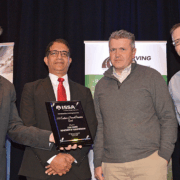
Pulaski County focused on moving from improving distressed pavements to preserving good pavements and was awarded for their achievements in the process. Nominated by EAE for outstanding efforts in pavement preservation, Pulaski County was the recipient of the 2023 James B. Sorenson Award for Excellence in Pavement Preservation. The prestigious award is presented by FP2 Inc. to recognize superior pavement preservation practice of a state agency, county, city or township.
https://ergonasphalt.com/wp-content/uploads/2025/11/Pulaski_County_1632x1224.jpg12241632Rick Potratz/wp-content/uploads/2024/08/asphaltlogo2.pngRick Potratz2023-09-29 20:35:532026-05-29 19:37:19Data-Driven Cape Seal Application Brings Pulaski County’s Roads to a Higher Standard
Choosing the Right Treatment Trial Run In 2017, ALDOT decided to test highly modified micro surfacing as part of their I-59 maintenance efforts. The treatment was applied along Mile Markers 19-21. Although highly modified micro surfacing had been applied on highways and in rest areas within Alabama, the 2017 project was the first on an Alabama interstate. Ergon Asphalt & Emulsions supplied eFlex premium micro surfacing emulsion for this project.
About eFlex Premium Micro Surfacing
eFlex is a highly modified micro surfacing emulsion designed to address oxidation, prevent further raveling of the OGFC and provide a continual high-friction surface, enhancing road safety. Its enhanced polymer modification allows for a service life extension of 7-9 years at minimum. While an eFlex treatment can be applied anywhere conventional micro surfacing is applied, it is more durable when applied on high-volume roadways, like I-59, than its conventional counterpart.
Application Highlights
In August 2017, Whitaker Contracting applied the highly modified micro surfacing treatment in two lifts. For the first lift, the treatment was applied at 22 pounds per square yard utilizing eFlex and Type III aggregate. For the second lift, micro surfacing was applied at 23 pounds per square yard utilizing eFlex and Type III aggregate. Traffic was returned to each treated section within an hour after the application.
To date, the eFlex-treated section of I-59 along Mile Markers 19-21 is holding up well. ALDOT believes they will receive at least 10 years of additional service life out of the treatment. Results thus far have led to more widespread use of highly modified micro surfacing on Alabama interstates, highways and rest areas.
Contact a local salesperson to find out if eFlex is the right solution to help improve your roads performance for the long haul.
https://ergonasphalt.com/wp-content/uploads/2026/03/Work-Truck-Above.jpg242363Olivia Tyler/wp-content/uploads/2024/08/asphaltlogo2.pngOlivia Tyler2019-11-11 14:58:032026-04-22 15:24:22Success of Ergon’s eFlex Solutions Prompts Dallas to Add Highly Modified Premium Micro and Slurry Surfacing to City Specs
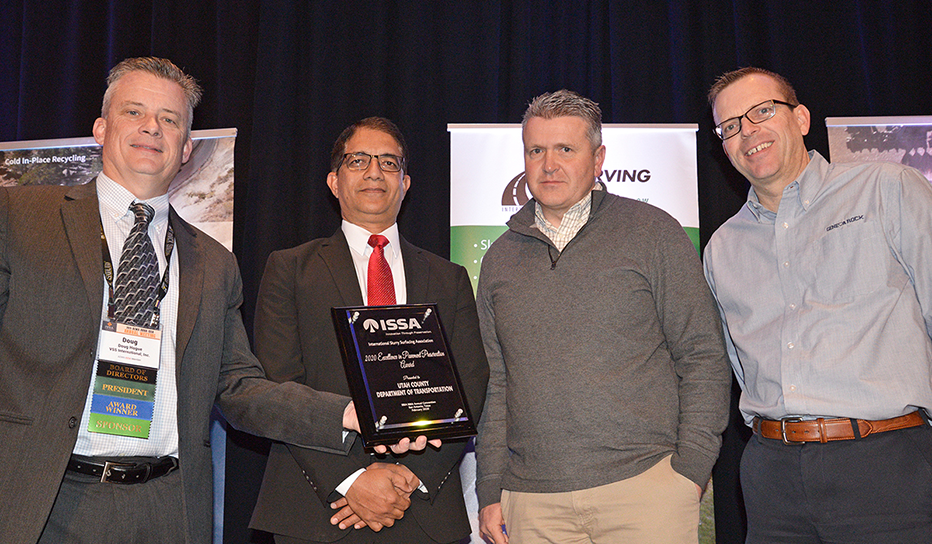
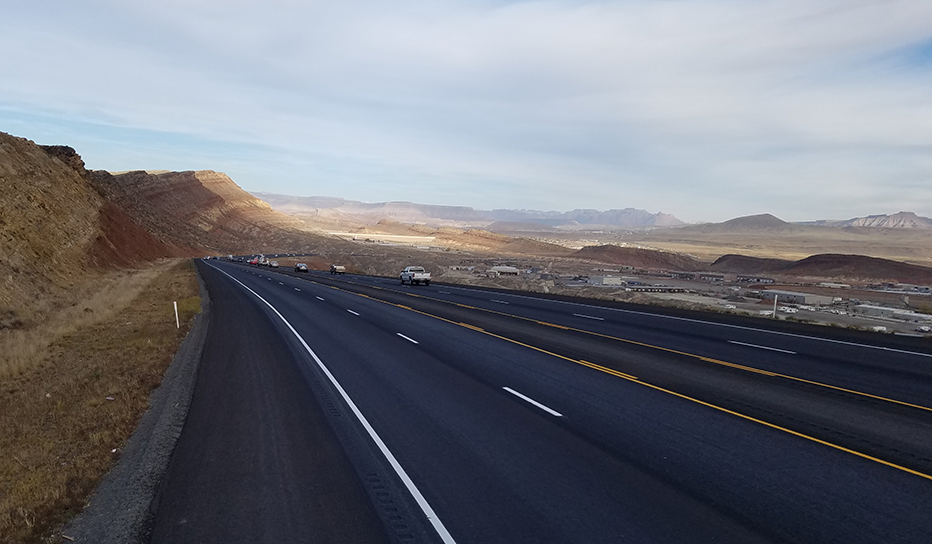
Background: Congratulations to the Utah Department of Transportation (UDOT) and contractor Geneva Rock, winners of the International Slurry Surfacing Association (ISSA) 2020 Excellence in Pavement Preservation Award. This $2.6 million high-volume preservation project on 10 miles of SR-9, leading from the City of Hurricane to Zion National Park, was part of UDOTs pavement preservation plan.
Distresses to the existing hot mix asphalt included block cracking, thermal cracking and raveling. Oxidation was prevalent, but the pavement was structurally sound. The long-term goals for the project included long-lasting mass crack treatment, restoration of oxidized pavement, and extended service life of 6-10 years.
Although UDOT has practiced the concept of pavement preservation for over 30 years utilizing micro surfacing and chip seals with the state of SR-9 at the time, they would have called for either a hot mix mill and fill or overlay. While both methods can be beneficial, neither was the most cost-effective method of treatment in this instance, since they wanted to restore and extend the life of the existing hot mix before reapplication was necessary.
Application Highlights: They decided to go with an innovative scrub/micro combination, or a cape seal. The area with more significant distress was treated first with 460,000 square yards of scrub seal, followed by 515,500 square yards of micro surfacing over the entire project. Incidentals included pedestrian ramps, signs, striping, HMA patching and rumble strips. Work was done during the day and at night. At least a single lane in each direction had to be maintained at all times due to the heavy traffic volumes experienced on SR-9.
This was the first scrub seal completed for UDOT, and they used the SR-9 project as a test to determine if this treatment would be suitable to rehabilitate oxidized and cracked asphalt surfaces in high-volume areas.
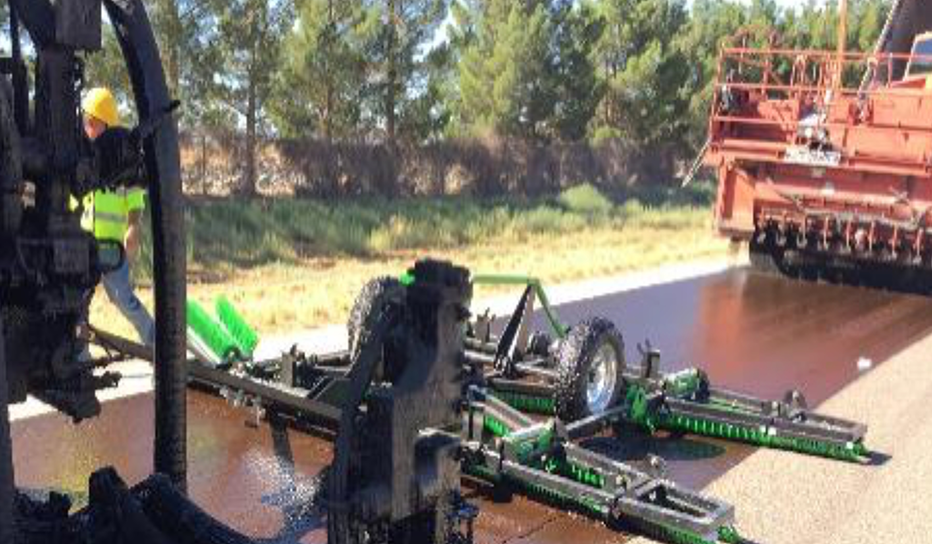
The scrub seal emulsion, CMS-1PC, was applied at 0.31 gallons per square yard, followed by a scrub seal broom (Greensbroom) and aggregate which was applied at 16-18 pounds per square yard. The micro surfacing was applied at 25.5 pounds per square yard using CQS-1HP emulsion at a rate of 12.5% with a Type III aggregate at 25.5 pounds per square yard. All aggregates were provided by Interstate Rock Products, and emulsions came from Ergons Las Vegas, Nevada, facility.
With a focus on quality control, UDOT sampled emulsions twice per load. Aggregates were sampled every 500 tons for both scrub and micro. The contractor and the aggregate producer also tested aggregate during production for consistent gradation. Emulsion was tested by Ergon per the quality control plan and formulated for optimum field performance.
Cost Savings: Not only was UDOT able to save 35% over the typical cost of a mill and fill, which has allowed them to treat even more miles within their network but the products and treatments used had a positive environmental impact as well, with less energy and less material needed for a cape seal than would have been required for a mill and fill.
Results: SR-9 has a fresh, new look and is now more durable and able to withstand pressure from repeat and heavy traffic.
https://ergonasphalt.com/wp-content/uploads/2025/12/ISSA-2020-EXCEL-IN-PVT-PRES-AWARD-copy.png544932Rick Potratz/wp-content/uploads/2024/08/asphaltlogo2.pngRick Potratz2020-06-19 12:28:592026-03-06 14:30:44Utah Cape Seal Project Wins ISSA Excellence in Pavement Preservation Award
The Rankin County, Mississippi, Road Department won both the 2019 Asphalt Emulsion Manufacturers Association (AEMA) Past Presidents Award and the 2019 International Slurry Surfacing Association (ISSA) Pavement Preservation Excellence Award for their 2018 Pavement Preservation Program which included the application of various treatments on over 100 miles within their roadway network.
Background
A little over two years ago, Rankin County recognized the need to take a more proactive approach to treating their roadways that would also make sense economically. Their goal was to be able to stretch their road dollars to treat more miles per year by using the right treatments on the right roads at the right time.
High-Performance Cape Seal (eScrub rejuvenating scrub seal +
eFlex high-polymer micro surfacing) on Old Brandon Road in Pearl, MS.
Members of the Road Department, including Road Manager Mike Harrison, attended seminars hosted by Ergon Asphalt & Emulsions (EA&E) and Etnyre and some national conferences to learn about the benefits and best practices of various pavement preservation techniques. From there, Mike, with the approval of the Rankin County Board of Supervisors, decided to move beyond the hot mix and conventional chip seals that had long been the typical go-to solutions for the county and test fog seals. They treated more than 30 miles of chip sealed surfaces throughout the county and, pleased with results, officially made fog sealing following chip seal applications part of their maintenance programs moving forward (when needed).
The fog seals helped lock down our rocks better so that they werent hitting cars, said Mike. A plus was that it also gave the roads a nice, darker appearance and made the striping stand out better.
Branching Out and Exploring New Treatments
Pleased with the success of fog seals, the county decided it was time to try another treatment micro surfacing. They performed a few demo projects in 2017, including a micro surfacing application on eight miles of LeBourgeois Estates subdivision, and were pleased with the outcome. Following the successful demo, the treatment officially joined fog seals as part of a new pavement preservation era for the county. And with micro, they found they were spending significantly less money per project than with hot mix applications. For the county, it was not about downplaying hot mix, but understanding there were other, less costly options for specific distresses.
In the spirit of trying new things, Harrison also decided to try polymer modified chip seal on a few roads to determine its benefits over the conventional chip seal emulsion that had been used for quite some time. It just seemed to hold up a lot better, said Mike. The county has since switched to polymer modified emulsion for all of their chip seal projects.
Cape Seal (Chip Seal + Micro Surfacing) in Live Oaks Subdivision in Brandon, MS.
Program Highlights
We are taking a more economical approach to enhancing our roads in order to be able to add more miles in our budget without having to sacrifice quality, said Steve Gaines, Rankin County Road Supervisor, District 4. In fact, implementing these new products on the right roads has resulted in even better quality than we had before, and feedback we have received from the community post applications has been great.
Treatments chosen as part of the countys preservation program included chip seals (single and double), scrub seals, micro surfacing and cape seals, which were applied in the county for the first time during the 2018 program year. In just two years, theyve gone from using only chip seals and hot mix, to strategically using almost every pavement preservation tool in the toolbox, said Amy Walker, EA&E Area Sales Manager and point person for Rankin County. EA&E was selected as the emulsion supplier for these applications, TL Wallace was the micro surfacing contractor, and Rankin County applied all chip and scrub seals in house.
In addition to the 55 miles of stand-alone chip seals (single and double) and the 31 miles of stand-alone micro surfacing, the county applied 12 miles of cape seal combination treatments on curb and gutter roadways in two subdivisions (six miles in Live Oaks and six miles in Barnett Bend) and two miles of a high-performance cape seal on Old Brandon Road, a high-traffic roadway in the center of downtown Pearl the largest city in Rankin County.
Introducing Cape Seals in Rankin County
The Live Oaks cape seal applications included polymer modified chip seal and conventional micro surfacing while roads in Barnett Bend, with cracks too numerous for a typical chip seal to address, were treated with a cape seal that included a rejuvenating scrub seal and conventional micro surfacing. The scrub broom was necessary there in order to force emulsion deeper into the more widespread cracks.
Old Brandon Road in downtown Pearl was a prime candidate for the high-performance cape seal including rejuvenating scrub seal (eScrub) and high-polymer micro surfacing (eFlex), as the heavily trafficked area would require an even more durable surface than conventional treatments could provide.
When it comes to maintaining our roads, its always our goal to utilize practices that allow us to extend our budget and make the most effective use of taxpayer dollars, Mike added. Learning about and applying the right preservation and maintenance treatments actually resulted in us having more money to spend in other areas. This was a learning curve for us, and we are still learning, but we will keep pushing forward knowing we have a winning strategy with the pavement preservation and maintenance concept.
The county noted that using these various treatments at the right time on the right road did in fact result in them being able to treat more miles than in previous years. Having a plan for what they would do also helped them better communicate with homeowners on the front end about everything that would be taking place, which soothed potential tensions throughout the life of the projects.
Homeowners Note Appreciation for Treatments
Homeowners were pleased with the treated roads and were appreciative of the countys efforts to keep them informed of applications to take place in their respective areas.
Edwin Sallis, Secretary-Treasurer of the Palisades Homeowners Association said, Palisades community appreciates Rankin Countys dedication to ensuring well-maintained roads in a timely manner, and we are pleased with the maintenance work performed on roads in our subdivision. They are smooth and they have a nice appearance, which increases the value of the homes in the area. Rankin County did an excellent job informing us of the details of the project to take place, the expected time frame of the project and how homeowners would be impacted. A plus was that the micro surfacing applications provided minimal inconvenience because traffic was allowed back on the treated sections soon after application.
Mapping Out a Plan
Appeasing stakeholders and ensuring full transparency was a major impetus for the countys development of a pavement management plan, which included the logging and assessing of current roadway conditions in order to help make proper judgment calls regarding roads next in line for certain recommended treatments based on solid evidence.
As part of their management plan, the 2018 treatments have been logged and performance will be monitored, along with other roads scheduled for treatment. The plan will serve as an ongoing formula for improving the countys road network while also serving as a testament to the benefit of pavement preservation treatments.
Im really proud that our willingness to try new products and strategies to improve our roads has paid off and has been recognized by the AEMA and ISSA organizations, said Mike. We look forward to continuing with our new strategy, learning about new products and processes, and keeping taxpayers happy with how their money is being spent and the quality of their roads.
https://ergonasphalt.com/wp-content/uploads/2025/12/ourroads.com-Issue-1823.jpg632948Rick Potratz/wp-content/uploads/2024/08/asphaltlogo2.pngRick Potratz2019-08-27 13:25:272026-03-06 14:30:07Pavement Preservation Program Wins National, International Awards for Rankin County, Mississippi
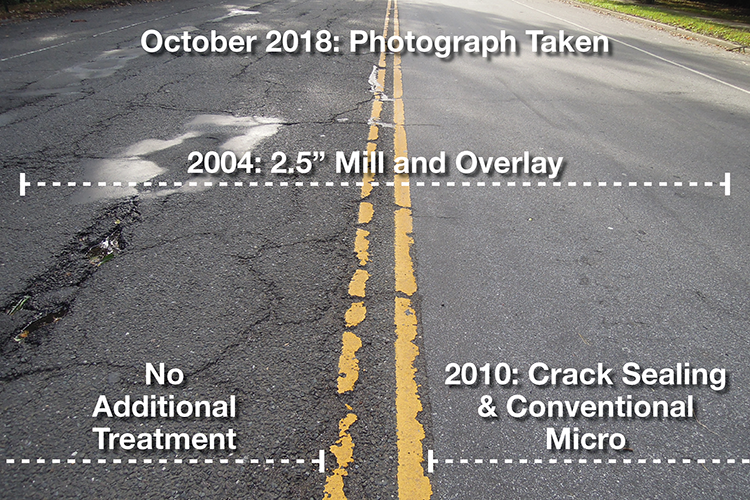
Rarely do we have an opportunity to see a side-by-side pavement preservation comparison one side of a road treated and one side not. The road shown below offers an indisputable picture of the benefits of pavement preservation.
This road is the border between two cities and was constructed in a joint project funded by both cities. Both sides were built from the same mix, by the same contractor, at the same time. The city on the left has not treated its side of the road since a mill and overlay in 2004. The city on the right did crack sealing and conventional micro in 2010.
The story gets even more interesting as the city conducts a study comparing conventional micro to highly modified micro.
eFlex Stands Strong, Passes Test in New England
In the City of Fairfield, Connecticut, the use of snowplows on roadways is essential to ensuring safe driving when harsh noreaster ice and snowstorms come roaring up the East Coast. These snowplows, while important, can wreak havoc on the condition of a road over time that is not properly preserved and maintained.
The City would typically apply conventional micro surfacing systems to treat these roads, but were approached with an opportunity to test a highly polymer modified micro surfacing developed to provide an even tougher, longer lasting solution to combat rutting from chains and delamination, among other distresses, caused by the constant snowplowing and pounding summer-time beach traffic.
Conventional Micro Surfacing
Micro surfacing is applied to provide a durable, rut-resistant and high-friction wearing course in order to protect the underlying asphalt surface, preserve the road and extend its service life for a number of years. However, micro surfacing treatments are known to be susceptible to raveling, scuffing and tearing in the vulnerable stage early after application. This can be caused by several factors including extremely high temperatures, repeated pressure and power steering burns from heavy trash trucks and city buses.
So, why use it? Generally speaking, agencies have found the long-term benefit of increased durability (as the components of the system begin to stiffen over time) to be effective, outweighing the short-term inconvenience.
Benefits of Highly Modified Micro Surfacing
eFlex premium micro surfacing is a stronger, highly polymer modified micro surfacing system that would protect Fairfields asphalt pavements and increase the durability of roads within their network. Increased levels of polymer modification in eFlex would offer greater resistance to damage that can occur soon after conventional micro surfacing applications by providing a tougher surface in a shorter period, minimizing the roads window of vulnerability. And it only gets better from there. When we initially came out with eFlex, we interviewed all the customers who had tried the product and the one single word that came across in every interview, without prompting, was the word, tougher, said Scott Metcalf, Vice President of Pavement Preservation & Specialty Products. I thought that was pretty amazing.
Flex Time
Upon reviewing product test sections, Scott Bartlett, Superintendent of Fairfield Public Works, decided to do a side-by-side and end-to-end test section of the eFlex product on three roads within the Citys networkPenfield Road, Rowland Road and Old Post Roadin order to evaluate the effects of four different micro surfacing treatments over time. On Penfield Road and Rowland Road, eFlex, Conventional Micro Surfacing, eFlex with fibers, and Conventional Micro Surfacing with fibers were each applied to a section for comparison purposes. Fibers were applied to some sections and not others to determine whether their addition would lead to a greater reduction in cracks over time. On Old Post Road, one section would be treated with eFlex and another section with eFlex and the addition of fibers for an end-to-end comparison.
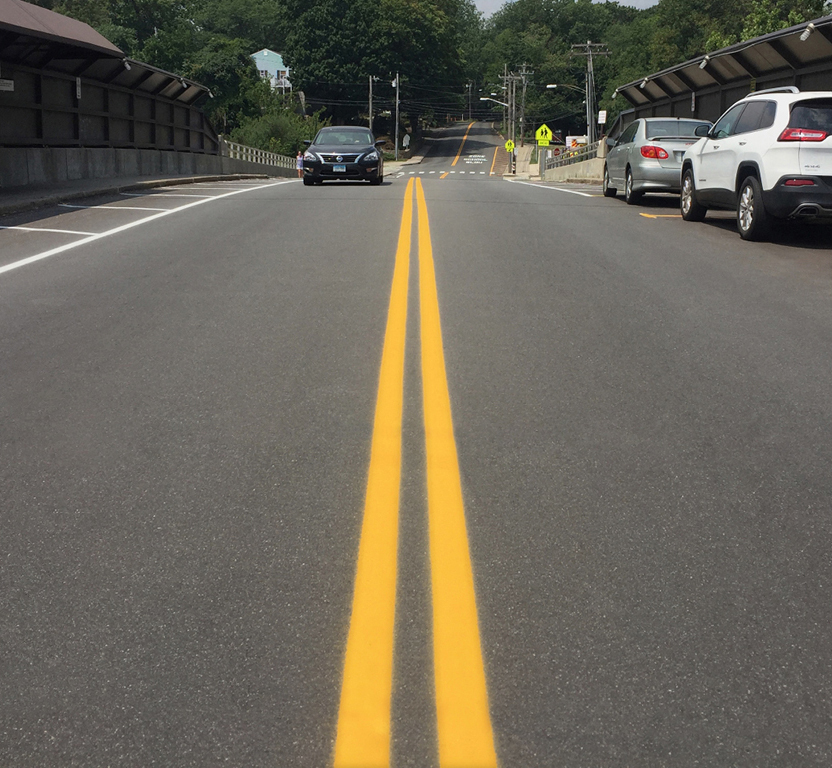
Caption: eFlex-treated road in Fairfield, CT, two years after application.
Each of the applications was applied in double lifts, resulting in a 30 pound per square yard of dry aggregate application on each road. The eFlex-treated roads showed 40% less scuffing weeks after application. It was noted that the addition of fiber in both the eFlex polymer modified and the conventional micro surfacing systems had no significant impact on the occurrence of cracks.
It Keeps Getting Better
I believe eFlex is stronger, therefore we have less initial scuffing as well as longer-lasting performance, said Scott Bartlett. I estimate six years (of life extension) with conventional micro surfacing and feel I can get up to 10 years with eFlex.
Based upon the results of the eFlex-treated roads in comparison to the roads treated with the conventional micro surfacing system, Fairfield found eFlex to not only reduce initial scuffing, but also hold color longer and provide an increase in the life cycle. The City experienced a 70% reduction in post project sweeping and the severity of power steering burns was also dramatically reduced post application. In fact, two years later, the roads treated with eFlex are on target to meet Fairfields initial desire for longevity and protection of their investment in their network.
We have successfully used this product across our entire network of streets and are confident it will work on higher traffic roads as well as heavy truck routes (as we are seeing) no sign of shoving or rutting, said Scott Bartlett.
The Right Treatment on the Right Road at the Right Time
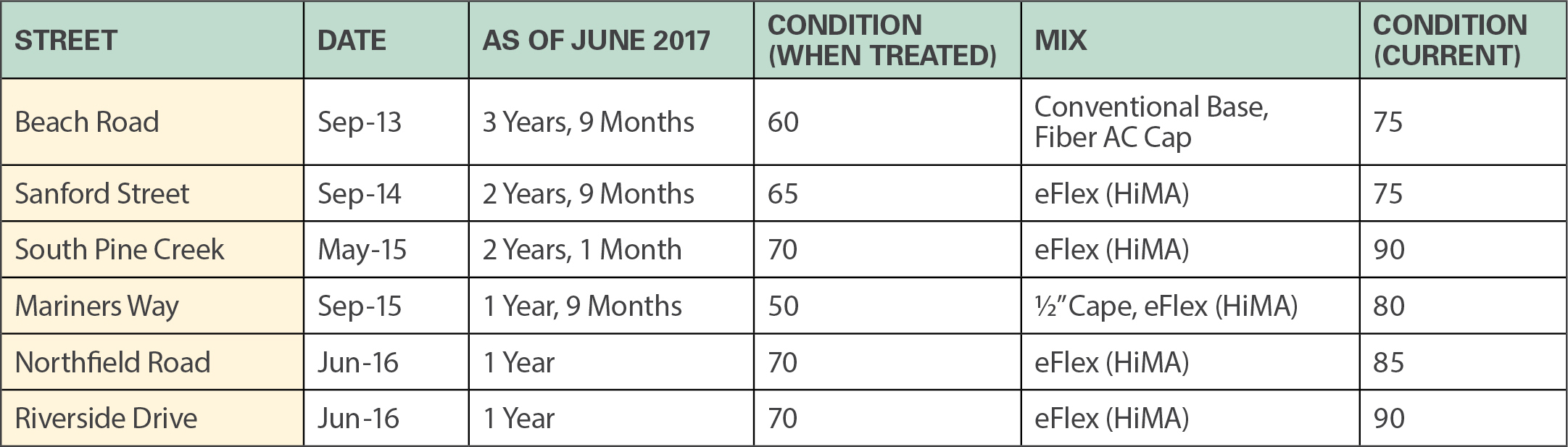
Figure 1. PCI of treated roads at the time of application and as of June 2017.
The City of Fairfield was so pleased with the performance of the highly modified micro surfacing that they have changed their micro specifications to 100% eFlex. They have kept a log of the performance of roads within their network that have been treated with eFlex, as well as one road treated with a conventional hot mix overlay and a fabric interlayer, for comparison purposes. Figure 1 (above) shows the PCI of various roads from the time of application to June 2017. Results from these eFlex projects show highly modified micro surfacing is the proper solution for tougher roads long term, and that treating roadways at the proper time in their life cycles can results in significant improvements in their PCIs.
Hot Mix Asphalt is a crucial and important asset to any road network. It provides a durable, smooth surface with a rich, dark appearance commuters and agencies have come to appreciate and associate with a good road. It is, however, an expensive asset that can deplete road budgets in a less than efficient way when not maintained correctly.
Maintaining Hot Mix?
If you could afford to pave 10% of your network each year, you could apply and reapply hot mix and achieve great results. However, as few agencies have that luxury, consider the fact that with the same budget, you could achieve the same great results for a longer length of time, and as a bonus, cover more miles per year. Thats what pavement preservation is all aboutlong-term maintenance of a roadway network through regular treatments of the roads at different stages in their life cycles. You can actually improve the overall networks health while staying within budget.
What Could You Do With $1 Million?
The City of St. Petersburg, just south of Tampa, FL, is no stranger to the concept of pavement preservation. Up until a few years ago, they allocated approximately $1 million of their annual $4.5 million road maintenance budget for micro surfacing treatment for their 2,000 lane mile network.
Micro surfacing is typically used as a preventive maintenance solution for roads in moderately good condition, in order to raise their Pavement Condition Index levels and keep them in good condition longer.
In the past, the poor performance of a specific micro surfacing system caused the city to reevaluate its use, spending the $1 million for hot mix asphalt overlays instead. While its an understandable response, hot mix overlays are between two to three times the cost of micro surfacing. In the case of St. Petersburg, by placing hot mix asphalt alone, they were limited to less than 99 lane miles of treatment per year. By reassigning $1 million to micro surfacing, that same $4.5 million budget could treat over 122 lane miles, an increase of almost 25%.
An Improved System Offers a New Opportunity
The city found themselves in need of a more cost-effective solution than the hot mix overlays and began looking into other treatments, even reconsidering micro surfacing. Ergon Asphalt & Emulsions, Inc., (Ergon A&E) took on the challenge of reviving the micro surfacing reputation in St. Petersburg with eFlex premium micro surfacing, a cost-effective pavement maintenance solution that provides increased durability and friction due to high levels of polymer modification.
The city agreed to a micro surfacing demo on four roads within their network. Two would be treated with eFlex while the other two would be treated with a standard micro surfacing system. Ergon A&E planned to prove eFlex as an improved and longer lasting solution.
17th Avenue prior to eFlex application.
One of the sections to receive eFlex treatment was 1,280 linear feet of 17th Avenue South, which was in moderately good shape, but displayed cracking, medium severity weathering and raveling. The other section was 1,490 linear feet of 11th Avenue South, which displayed cracking, high-severity weathering and raveling. This road runs adjacent to a high school and has a high traffic volume.
The roads to receive the standard micro surfacing treatment were 1,300 linear feet of 35th Street South and 1,040 linear feet of Queensboro Avenue. These roads also displayed cracking as well as weathering and raveling.
Whats the Catch?
It is recommended that cracks ¼ or larger be sealed prior to micro surfacing for best results. While micro surfacing can make large cracks significantly smaller, the system can be too stiff and too thin to stop working cracks from returning. In addition to evaluating micro surfacing performance, St. Petersburg would also use this demo to test the effectiveness of their crack sealing program/methods, filling cracks along certain portions of 17th Avenue and Queensboro Avenue to be treated, and then comparing them to sections that were not crack filled. Crafco, Inc., was selected to supply the crack relief product.
Demo Time
A double lift of eFlex (30-34 pounds) was applied to 17th Avenue, with nearly 650 feet of the 1,280-foot demo section crack filled prior to application. A single lift of eFlex (20-24 pounds) was applied to the demo section on 11th Avenue, which did not receive a crack fill prior to application. Each treated section cured in less than an hour.
17th Avenue after eFlex application.
Over on Queensboro Avenue, a double lift of standard micro surfacing was applied, with nearly 650 feet of the 1,040-foot demo section crack filled prior to application. On 35th Street, a single lift of standard micro surfacing was applied without prior crack filling.
The demo sections will be monitored for the duration of one year. Based on overall micro surfacing performance, the city may once again consider bidding for micro surfacing projects as part of their network maintenance program.
Ergon A&E representatives were on site throughout the demo project to offer assistance and ensure treatment was applied according to best practices. The city was pleased with the process, neatness of operation and the cure time of the eFlex application.
11th Avenue after eFlex application.
A Proven Formula
Once you identify the variables in a proven equation, youll get the right answer every time. The adage treat the right road with the right treatment at the right time is a mainstay in the effective management of an agencys network. There are many factors involved in proper road maintenance, but when applied correctly, the pavement preservation concept works and can stretch your budget miles down the road.
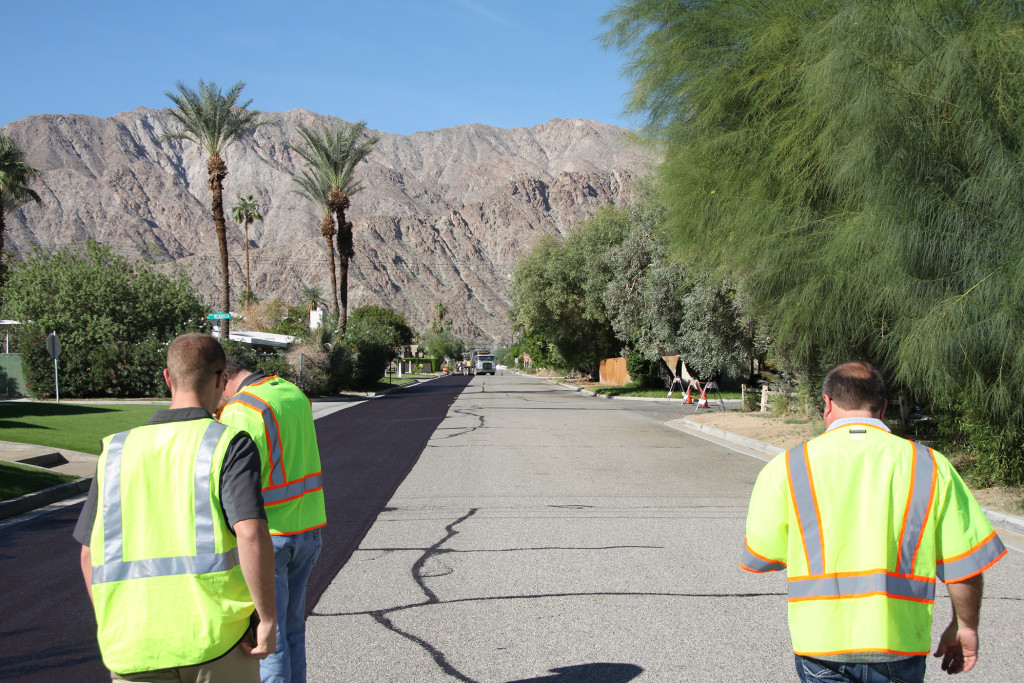
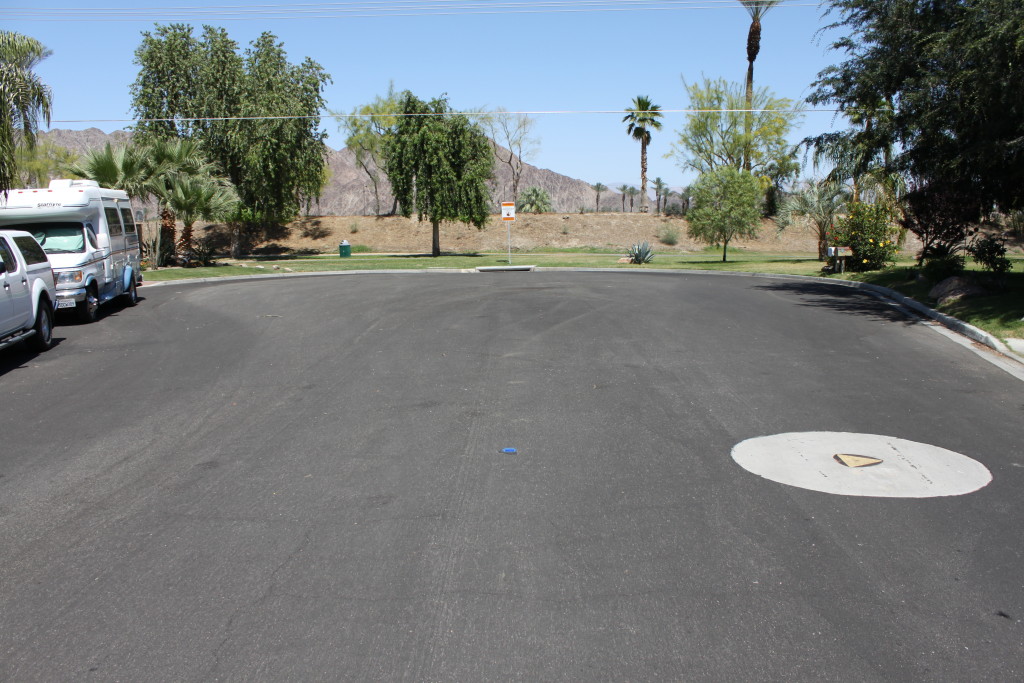
Background: Surface Damage Arises in Southern California
Some cities in California often experience road surface temperatures as high as 160°F, creating vulnerability in the roadways. For some residential streets in LaQuinta, California, just outside of Palm Springs, this vulnerability led to distresses such as hairline cracking, minor thermal cracking and aged, oxidized surface raveling. Crack sealer and traditional slurry seals had been applied to correct these issues in the past. It was discovered over time, however, during bouts of extremely high temperatures, traditional slurry seals are more susceptible to power steering burns and scuffing. This damage is often caused by local automobile traffic and utility traffic, such as garbage trucks.
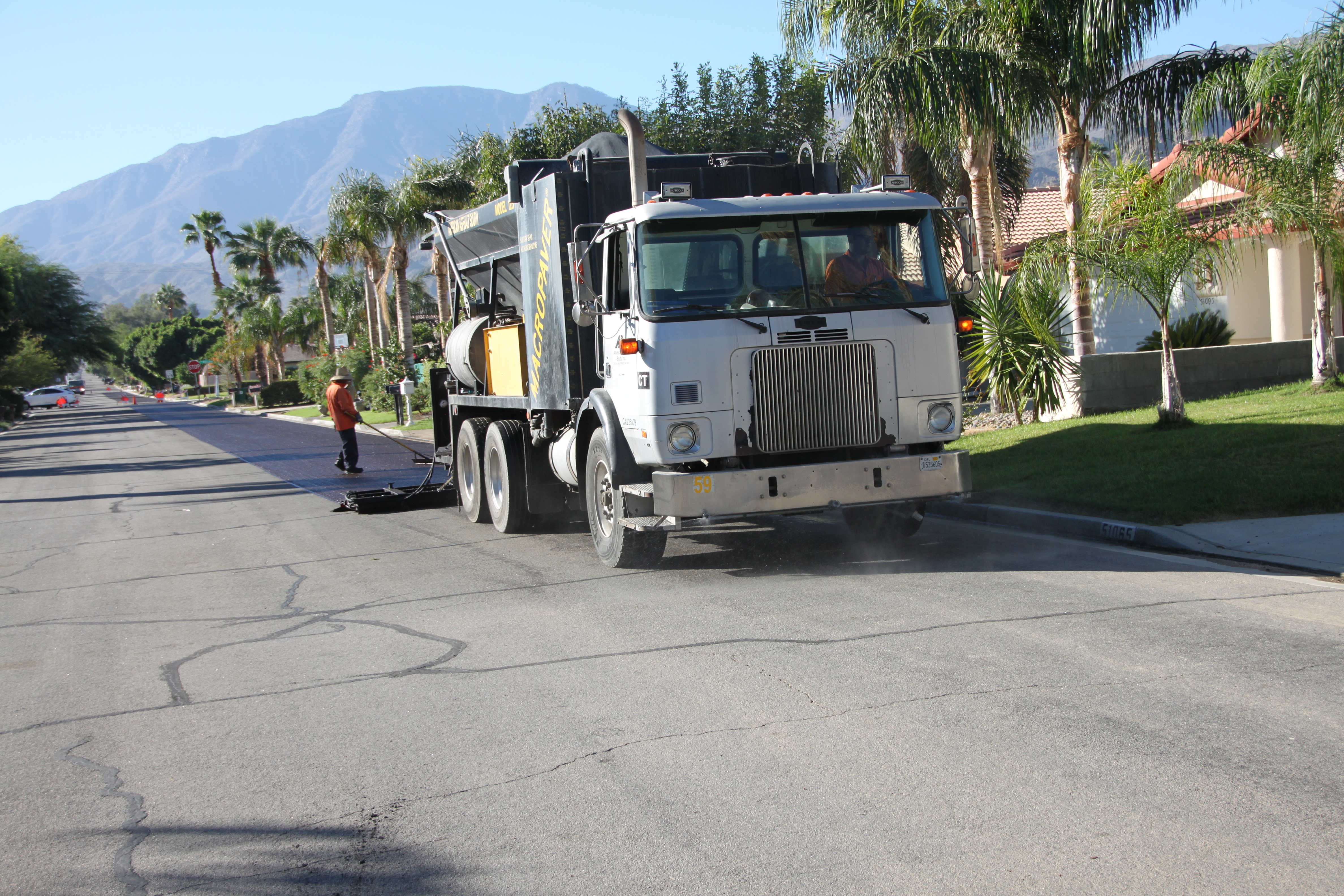
American Asphalt South, Inc., (AAS) with Vice President Jeff Petty as Project Manager, was contracted to carry out a road maintenance plan using latex modified slurry seal. Latex modified slurry seals are more abrasion resistant than traditional slurry seals due to their polymer content. However, in extreme climate conditions, such as those in southern California, even modified slurry seals can often fall victim to extensive surface damage from the heat. American Asphalt South, Inc., (AAS) with Vice President Jeff Petty as Project Manager, was contracted to carry out a road maintenance plan using latex modified slurry seal. Latex modified slurry seals are more abrasion resistant than traditional slurry seals due to their polymer content. However, in extreme climate conditions, such as those in southern California, even modified slurry seals can often fall victim to extensive surface damage from the heat. Ergon Asphalt & Emulsions, Inc.s Area Sales Managers Todd Vargason and Tom Hicks, both well-respected experts on pavement preservation in the region, became aware of the project and saw this as an opportunity to showcase Ergon A&Es new eFlex premium micro surfacing solution as a more durable and effective treatment.Ergon Asphalt & Emulsions, Inc.s Area Sales Managers Todd Vargason and Tom Hicks, both well-respected experts on pavement preservation in the region, became aware of the project and saw this as an opportunity to showcase Ergon A&Es new eFlex premium micro surfacing solution as a more durable and effective treatment.
eFlex, part of the e-Series family of pavement preservation and maintenance products, is an innovative new emulsion product ideal for residential applications due to its durability under stop-and-go traffic conditions. It is significantly tougher than its traditional and modified counterparts. Its increased level of polymer modification in the base asphalt gives roads greater ability to withstand extremely high temperatures. This promotes flexibility in the pavement surface allowing it to rebound from traffic friction, minimizing the negative effects of scuffing and power steering burns.
eFlex Takes on Latex Modified Slurry Seal
Meeting city specifications, AAS decided to test eFlex against the latex modified slurry seal and evaluate their overall respective performances. While a significant improvement in performance was expected with both competitively priced solutions over the traditional slurry seal, AAS was interested in noting whether eFlex would live up to its promises.
Application Highlights
The date for application was set for October 22, 2014. AAS primed the eFlex micro surfacing emulsion, combining it with crushed aggregate supplied by Coachella Valley Aggregates, Inc. Preparing for a smooth application, Ergon A&ETechnical Operations team members Bill Grubba, Vice President of Technical Operations & Plant Technology, and Joel Shealey, Technical Operations Manager, were on site for the duration of the project to address technical questions. Todd was also on site overseeing that proper proportion adjustments were made throughout the process. He also coordinated with Ergon A&Es Las Vegas emulsion plant to ensure a consistent supply of eFlex emulsion was on-hand for the project.
The treatment was applied at a rate of 15 pounds per square yard to a combined total of 23 blocks, along the 8 designated roadways. The eFlex cure time was less than two hours on each of the treated roads, allowing traffic to be returned to the surface with minimal inconvenience to local residents.
Results
The contractor was impressed with the overall performance of eFlex, and within the first week observed significantly improved resistance to tire damage. While a better alternative than traditional applications, latex modified slurry seals still showed considerable damage in extreme heat conditions. The contractor estimated an 80% decrease in power steering burns and scuffing on eFlex roads, as compared to the streets treated with latex modified slurry. There were no repairs necessary to the streets receiving the eFlex application. This is significant in that contractors acquire mounting repair costs addressing surface damage following the residential application of slurry seals. As an added benefit, there was no raveling present on the eFlex-treated streets and cul-de-sacs.
Project Update: Six Months Later
Six months following the application, temperatures began to rise above 100°F. Todd revisited the site observing sustained durability and protection from raveling in the eFlex treated cul-de-sacs. Scuffing also remained low, with approximately 80% less damage observed, as compared to the latex modified slurry seal surfaces. There have been no damage complaints from residents living on the eFlex streets.
Long-Term Strategy
Todd and Tom were major driving forces behind integrating eFlex into this project; its success further elevates their status as industry resources in the southern California region. Ergon A&E expects the outcome of this project will lead to a partnership with American Asphalt South to promote eFlex in 21 other desert cities in the Palm Springs area.
 Ergon Inc.


 Cape Seal (Rejuvenating Scrub Seal + Micro Surfacing)