What is Tack Coat?
Multiple asphalt layers create a single uniform pavement structure that flexes under stress. The bond that connects these layers is a thin liquid asphalt emulsion called tack coat. Ergon’s eTac is an innovative trackless bond/tack coat emulsion that provides exceptional adhesion between pavement sections, reduces slippage and allows for a significant reduction in delamination. Unlike the compromised bond of many traditional tack coats, which can cause pavement to slide under traffic loads resulting in slippage cracks and failure, eTac is designed to hold tight to asphalt and the bond created melds asphalt layers into one cohesive pavement unit. These attributes made eTac the ideal solution to test along U.S. Route 160.

U.S. Route 160 Project Details
Over two days in mid-October 2021, eTac was placed on a hot mix pavement project mat along U.S. Route 160 west of Kayenta, Arizona. Ergon Asphalt & Emulsions supplied the eTac and on Thursday, October 14, Fann Contracting began applying the trackless tack at shot rates of 0.08, 0.10 and 0.12 gallons per square yard. Friday’s demonstration included additional sections that received eTac at 0.10 and 0.12 gallons per square yard. “At the start of demonstrations, the morning ambient and pavement surface temperatures for both days registered below 40°F. By early afternoon, temperatures were in the upper 40s,” said Nye McCarty, P.E., ADOT’s Flagstaff Regional Materials Engineer. “The emulsion had been kept in a distributor truck since the week prior due to weather delays but remained very stable. It was in a non-tacky state within 10 minutes and was fully broken within 15 minutes. No tracking of any kind was observed after the material had completely broke.” Compared to conventional tack coats, the benefits of eTac were immediately realized as the liquid emulsion held tight to the asphalt and did not pull up onto tires and equipment. Once the asphalt was fully cooled, it was on to the lab for bond strength testing.

Shear Bond Strength Testing of eTac
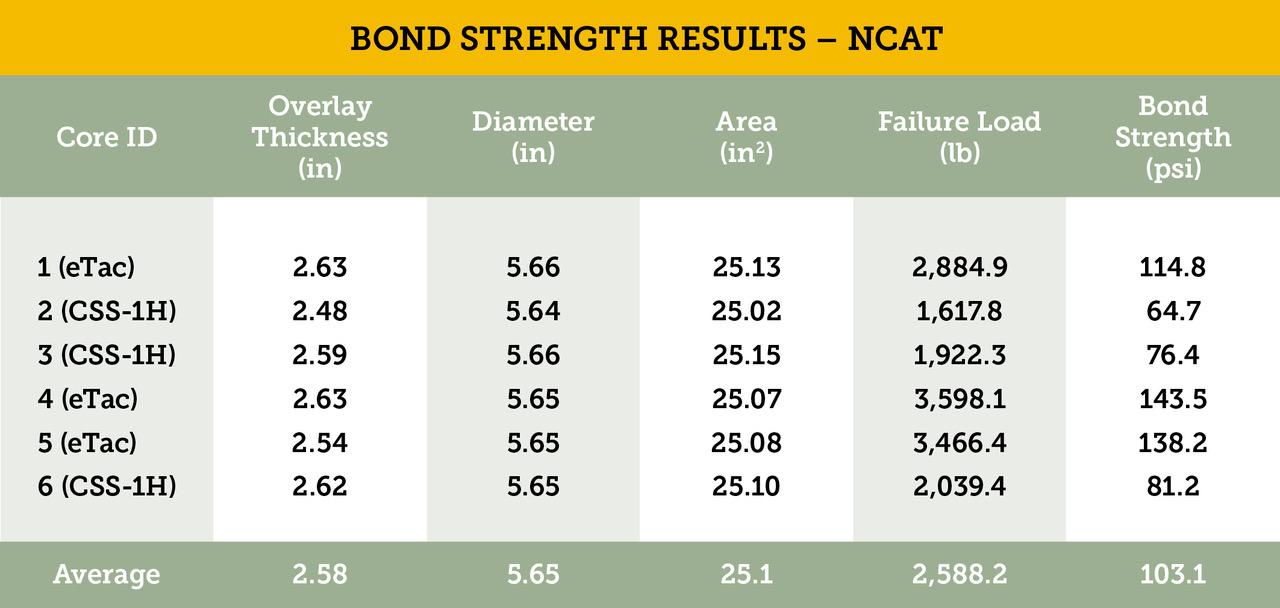
ADOT took 6-inch diameter full-depth cores for each application rate placed both Thursday and Friday and sent samples to the National Center for Asphalt Technology (NCAT) laboratory for shear bond strength testing. Previous attempts to obtain full-depth cores from where conventional CSS-1H was placed proved challenging according to ADOT, as the new asphalt delaminated from the old asphalt while coring. Bonding strength over 100 psi is considered passing by some state agencies. Results below illustrate eTac’s remarkable bond strength (psi) numbers.

test

__________________

Status of shear testing for U.S. Route 160’s tack cores as of October 2021. Data provided by NCAT.

eTac Core Samples Register Remarkable NCAT Bond Strength Test Data
ADOT project personnel were extremely pleased with the performance of eTac on U.S. Route 160. eTac’s ability to properly bond to asphalt not only provided ADOT with full-depth core samples to test, but the trackless tack coat’s firm grip to asphalt also reduced cleanup time and crew exposure to traffic — all important elements in achieving safe roads built to last. Contact your local Ergon representative for more information on how your roads can benefit from eTac.
Project Details – I-75/FDOT District 7
Pavement along the 130-lane-mile section of I-75 was milled, and eTac, a trackless bond/tack coat provided by Ergon Asphalt & Emulsions, was applied over the milled surface at a shot rate of 0.07 gallons per square yard. eTac’s fast break time allowed crews to begin paving within five minutes of application, cutting construction time.

___________

Benefits of Tack Coat (Bond Coat)
Tack coat serves as a bonding agent that prevents asphalt from slipping and sliding and creating unsafe driving conditions that can be costly to repair. Ergon A&E offers both emulsified and hot-applied trackless bond/tack coats that provide strong adhesion between asphalt layers. Together, these bond coats make up the eTac family of trackless bond coats, part of Ergon’s exclusive eSeries product line.

___________

Preferred Materials has found the eTac emulsion yields exceptional results beyond what they’ve seen with other tack coats. “The bonding strength of this product actually exceeded that of other rapid set and medium set tack coats,” said Rick Crocker, operations manager for Preferred Materials – Tampa. “eTac didn’t track out onto any adjacent roadways or ramps and didn’t make a mess on the project site.”

Following the eTac application, Preferred Materials applied a two-inch, compacted structural course using PG 76-22 liquid asphalt. An open-graded friction course surface was added as a measure to enhance public safety during rain events.

This treated section of I-75 is the smoothest roadway in the history of the state of Florida. “It may even be the smoothest section of interstate in the country right now,” said Crocker.

Preferred Materials was awarded the 2022 A.P. Bolton Award for their outstanding road work on this project, particularly for exceptional performance of the road section post application. This is their third consecutive A.P. Bolton Award.

What Makes a Winner?
Factors that led to Preferred Materials’ 2022 A.P. Bolton Award for the I-75 project include optimum roadway performance, a composite pay factor (CPF) of 104.5% and an International Roughness Index (IRI) rating of 24.

Composite Pay Factor
A CPF is comprised of individual factors such as quality control of products from the plant to the application site and performance of the final product. The highest achievable CPF percentage is 105%.

International Roughness Index
The purpose for the IRI test is to determine the smoothness or rideability of a roadway. “You want your number to be as low as you can get it,” said Crocker. The lower the IRI, the smoother the ride quality. The highest IRI number a road can get before having to undergo reconstruction is a 95.

A good CPF percentage and IRI combined provide benefits that drivers, agencies and contractors alike, appreciate. For drivers, a high CPF percentage and low IRI indicate a better ride that is often safer. For agencies and contractors, these standards indicate reduced risk of early wear and tear and reduced maintenance costs.

What Impacts Composite Pay Factor and Roughness?
Situations that could lead a roadway to delaminate or unravel and fall apart in an untimely fashion include subgrade issues and lack of bonding between lifts. These failures would indeed impact the CPF and IRI outputs. Crocker says tack coat was key to the exceptional CPF and IRI numbers that the completed I-75 section achieved. “If we were utilizing a tack that didn’t perform very well, the project would not have turned out the way it did,” he said. “There are a lot of factors that play into making a road this smooth, but certainly one that can’t be overlooked is tack coat.”

Preferred Materials has utilized eTac on many paving projects over the years. “Our commitment to excellent customer service and, of course, the performance of our product, have put us in good standing with the company,” said Joey Gelwix, Ergon A&E’s Florida area sales manager.

Going for National Gold
Since the 130-lane-mile I-75 project, there has been no delamination or roadway deficiencies. “It’s been a very good-performing roadway,” said Crocker. In addition to the recent A.P. Bolton Award, Preferred Materials also received the FTBA Best in Construction-Interstate Award for this project, and plan to nominate it for the National Asphalt Pavement Association’s Sheldon G. Hayes Award for excellence in construction of an asphalt pavement.

Major Tracking Issue Removal

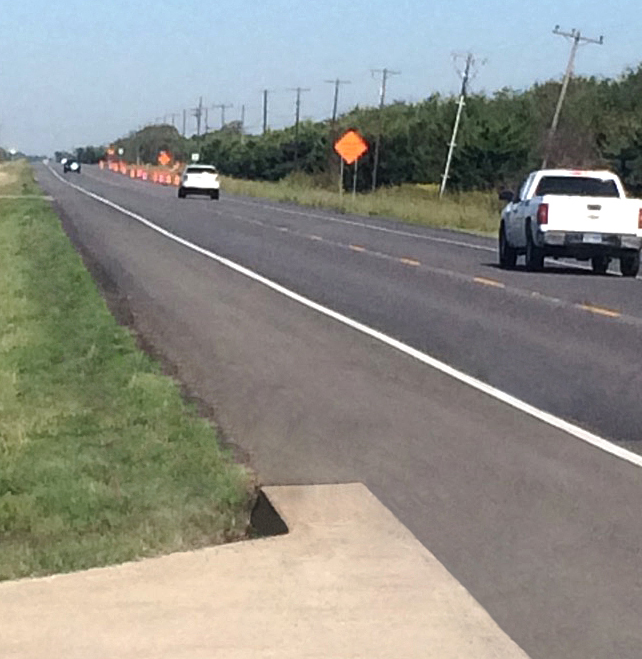
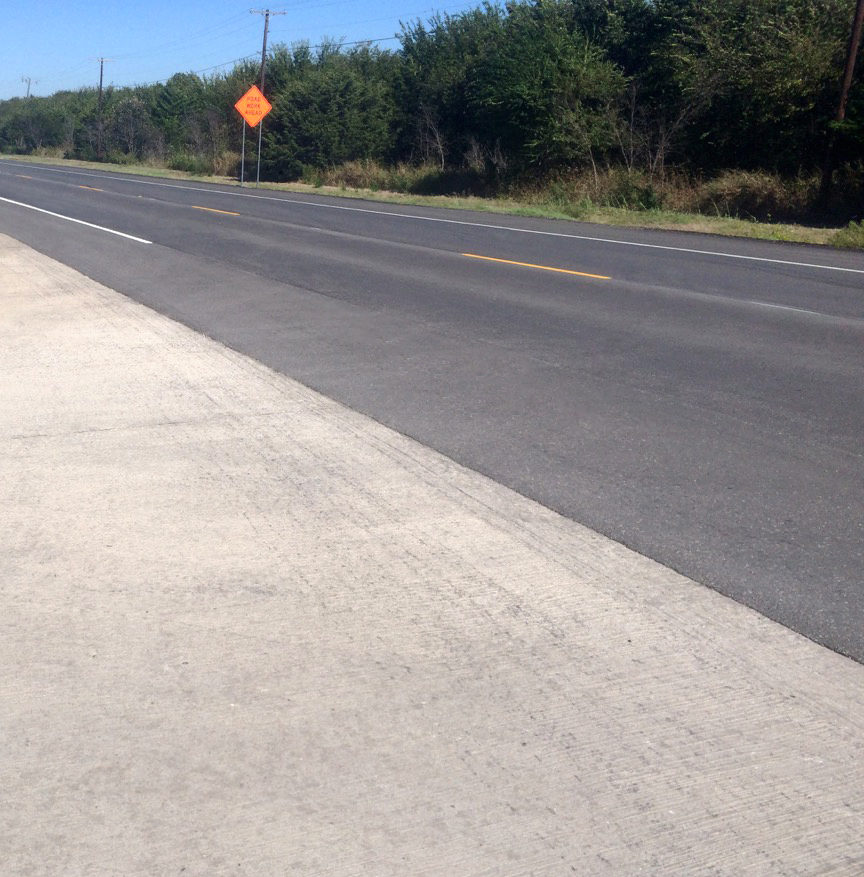
(Highway 5 after mill and fill using eTac and Hot Mix Asphalt.)

Background

Bond Coats are used to prevent slippage and promote a strong bond and solid adhesion between two asphalt layers. However, general tracking issues associated with conventional bond coats can be a hassle to clean and can slow valuable production time.

Five miles of an 8-year-old Hot Mix Asphalt (HMA) surface along Highway 5 (SH 5) near McKinney, Texas, had become oxidized and began to crack. Texas Department of Transportation (TxDOT) determined this section would receive a mill and fill with HMA. The agency typically applies new HMA to road surfaces every 8-10 years, or when distresses occur, in order to maintain the integrity, look and feel of the roads.

There were many concrete driveways along SH 5 where the HMA would be applied. A major concern for TxDOT and the contractor, Jagoe-Public Co. (Jagoe), was completing the project with as little tracking as possible in order to minimize the time and costs associated with having to power wash excess tack off of the driveways and construction equipment, and maintain an aesthetically pleasing roadway for the public. They also wanted to ensure a reduction in the risk of the tack causing damage to vehicles. To address these concerns, TxDOT decided to try eTac bond coat, provided by Ergon Asphalt & Emulsions, Inc. (Ergon A&E).

Strong Tack that Stays Put

eTac is a user friendly, storage stable bond coat with properties proven to provide less tracking over conventional bond coats, even on milled surfaces. This is not an easy task, as bond coats applied to these types of surfaces must combat the significant amount of dust that accumulates on the surface following a milling treatment. In certain instances, bond coats sprayed into milled grooves would fail to cure properly, compromising the performance of the tack and that of the HMA surface. Also, because eTac is specifically designed to eliminate tracking issues, contractors don’t have to worry about paving equipment picking up the tack from the surface during application.

Consistent Results

The previous asphalt surface was milled a few weeks prior to the eTac application. Then, sections at a time, the contractor applied eTac at an application rate of 0.08 – 0.10 gallons per square yard. The eTac emulsion consistently broke within eight to 10 minutes and construction crews were able to then begin the hot mix overlay. This portion of the project was completed in 12 working days.

image3
(Highway 5 after mill and fill using eTac and Hot Mix Asphalt – no tracking)

“This stuff is great…Performs the same every time. We were able to get back in the mat within 10 minutes, which really helped our production.” – John Belcher, Jagoe General Supervisor.

Applying eTac saved both time and money, as major post-tack cleaning efforts were no longer a concern. More importantly, eTac eliminated the possibility of slippage and early road distresses often associated with poor bonding. Both TxDOT and Jagoe plan to continue to utilize eTac in applications where less tracking is critical.