Ergon’s ePrime, an environmentally friendly, solvent-free prime coat was selected for use in the iconic national park.

Background

Yosemite National Park is one of America’s national treasures. This park is home to large and rare sequoia trees, incredible waterfalls, mule deer, black bears and other wildlife. It receives hundreds of thousands of visitors per month and millions annually. People may be most familiar with the park’s half dome and glacier-carved valley, both subjects of some of the world’s most iconic pictures.


The Central Federal Lands Highway Division serves as the agency managing Yosemite’s road networks. They recently reconstructed the park’s south entrance, part of State Route 41 (SR 41) and 2.5 miles of Mariposa Grove Road, where tourists go for a close-up view of the sequoia trees. ePrime, an environmentally friendly, solvent-free prime coat supplied by Ergon Asphalt & Emulsions, Inc., (EA&E) was selected for use on this project.

The Challenge: Constructing New Pavement Sections While Open to Traffic

Priming an aggregate base is an important step toward preventing slippage, as the total road structure is bonded together in a homogenous manner (becoming one), which results in a significant increase in the overall strength of the asphalt pavement. One of the challenges for Central Federal Lands was finding a prime coat that would be environmentally friendly and allow for same-day construction, cross traffic, and paving, as contractors usually have to wait up to 48-72 hours before paving over solvent­ containing prime coats.

Solution: ePrime Environmentally Friendly Prime Coat

Upon researching alternatives that would cut down the amount of waiting time after a priming application, Central Federal Lands and the contractor, Herback General Engineering (HGE), determined ePrime was the solution that would meet their desire to achieve same-day paving.

This fast-curing prime coat is designed to significantly reduce slippage, and the fact that it is VOC-free was a huge plus for Central Federal Lands because strict regulations are in place to ensure products used for various Yosemite Park projects are safe for its sensitive environment. The only other alternative was priming using SC-250 cutback asphalt, but same-day paving cannot be achieved with this method.

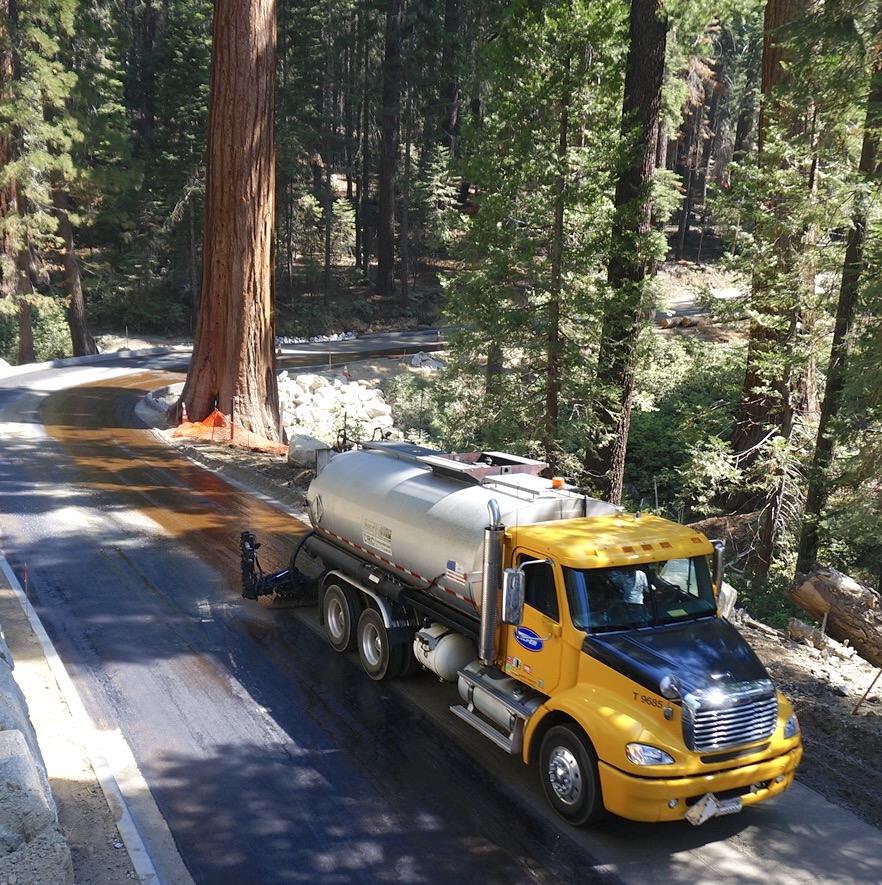
ePrime application on Mariposa Grove Road (just under 5000 ft. elevation).

Application Highlights

EA&E had representatives on site to assist HGE with determining the correct application rate, as well as other technical aspects of this project. ePrime was applied at 0.15 gallons per square yard one lane at a time, curing in 30 minutes to an hour and supporting paving in three hours. The project began in August of 2017 and was completed in two phases.

Phase One: Mariposa Grove Road

The first phase completed was work on the 2.5-mile stretch of Mariposa Grove Road, which was closed to tourist traffic during this process, but not to construction traffic, as there were projects on each end of the section to be reconstructed. This meant heavy equipment from other contractors rolling over the ePrime-treated section repeatedly. However, because ePrime was developed to perform well in such scenarios, the treated road held up and was able to withstand the heavy traffic until the overlay could be applied. Due to a delay on some sections along the 2.5-mile segment , the ePrime was in place for nearly three weeks prior to being paved, protecting the roadway base which remained strong and intact.

ePrime-treated road weeks after application, prior to paving.

Phase Two: SR 41

The last part of the project, completed in October of 2017 at an elevation of just under 5000 feet, was the south entrance (part of SR41). During this phase, incoming park traffic was allowed to drive on the ePrime-treated surface; there was no alternative because the entrance is a two-lane road. In spite of the weather concerns and the high traffic level, ePrime performed well during construction. “The ePrime broke quickly and allowed us to run construction and park traffic on it until we could overlay it,” said Peter Griffin, Project Manager / Estimator – HGE. “It was very durable and held up well.”


ePrime provided the solid foundations needed in order for the hot mix asphalt overlays to adhere to the aggregate bases of the two Yosemite Park roads, preventing slippage and ensuring the asphalt would stay in the respective lanes.


Yosemite is just one of a long line of national parks in the western U.S. where ePrime has been applied. Others include Lake Mead National Park, Joshua Tree National Park, Zion National Park and Bryce Canyon National Park, just to name a few.

Post updated 5.8.19.

reconstructed road protection 3

Background

Kolob Terrace Road winds through mountains and canyons of Zion National Park in Southwestern Utah. With massive drop-offs and no shoulder, the road is closed during winter months when covered with snow and ice. Following a spring thaw, officials found that deep thermal cracking and erosion had made it inadequate for public use.

A Stronger Solution

The Federal Highway Administration (FHWA), charged with planning and construction, sought a long-lasting, economical and prompt solution to widen and replace an 11-mile stretch of Kolob Terrace Road, creating a stronger and safer surface and extending its service life. Superpave® Hot Mix Asphalt (HMA), PG 64-28, was chosen as the new surface layer.

They then needed a product that would protect the new expanded road base during construction and provide a strong bond between the base and the HMA surface. After evaluating various primers, they chose Ergon Asphalt & Emulsions, Inc.’s ePrime for its dust-prohibiting qualities, eco-friendliness, low-track and rapid cure time.

ePrime is designed to protect the road base from moisture during the construction phase, its most vulnerable period. It also creates a bond between the base and subsequent asphalt layers to prevent slippage. Solvent-based cutbacks can provide similar results, but they are environmentally unfriendly as well as a health concern due to the use of kerosene in the emulsion compound of conventional prime coats. ePrime’s solvent-free formula makes it environmentally friendly and less offensive to road crew workers. Its fast cure time also allows for same-day paving, usually within just a few hours of application.

“I wouldn’t use anything else on a project like this,” said Jared Bouy, Western Rock Superintendent. “I would use ePrime before MC70 any day. You would have to wait two to three days on MC70 to set, when you could spray ePrime in the afternoon and pave on the base the next morning.”

Building the Base

Rees Construction, the primary contractor on the job, milled the existing road surface to expose the underlying base. Considerable time was taken to create a more stable road base, and in some areas GeoTech metal mesh fabric was installed to help expand and further reinforce the new base in preparation for the HMA application.

Zion pic 4b

Application Highlights

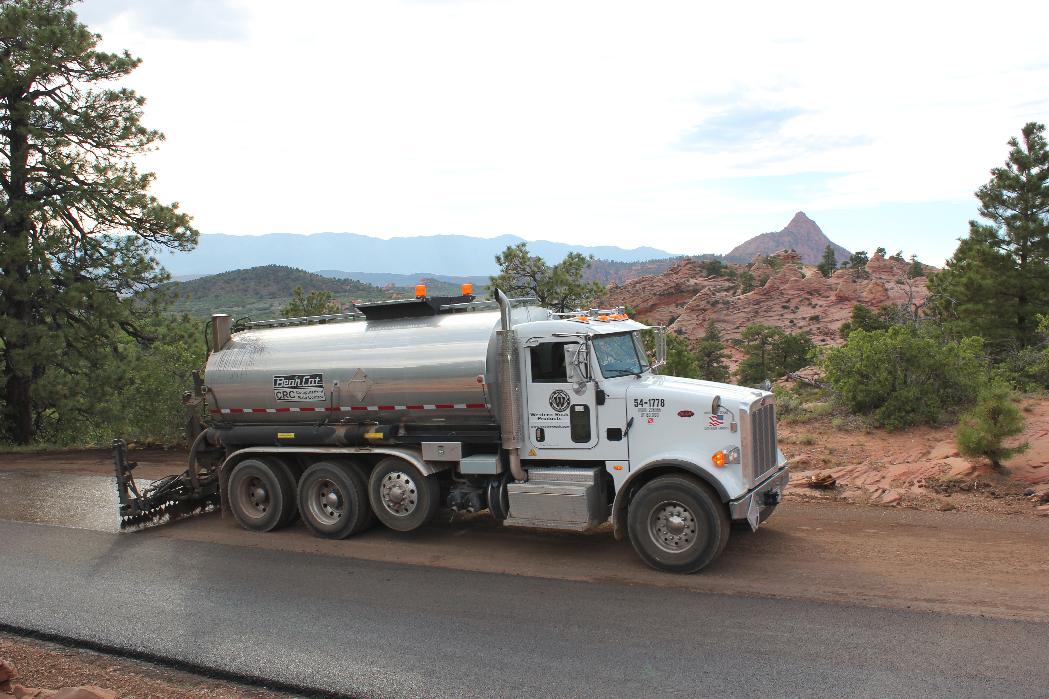
On the first day of application the ambient temperature was 95°F and the land surface temperature was approximately 110°F. The contractor selected for the ePrime application and paving portion of the project, Western Rock Products, began preparations by diluting the priming emulsion at a ratio of 1:2. After four test sections to optimize application rates, HMA design and rolling patterns, the ePrime treatment was applied at a shot rate of 0.15 gallons per square yard over the eastbound lane of the first 1.5-mile stretch, beginning at approximately 1:00p.m. By 7:00p.m. that evening, the road was reopened to traffic.

The next day, Western Rock paved over the initial section and then applied ePrime in the westbound lane around 4:00p.m. The construction crew was able to begin paving the next morning. In just two and a half days Western Rock had 1.5 miles of the project primed and paved with a 2-inch lift.

Results: Better Road…Lower Price

Thanks to ePrime’s rapid cure time, the project moved forward in a timely manner with minimum impact on the traveling public. Western Rock was pleased with how well ePrime held up, and Mike Dance, representative of Landmark Testing & Engineering, was particularly impressed with the speed of application and durability of ePrime.

Cost Savings

Using ePrime saved the FHWA $50,000 over the cost of traditional methods and provided Kolob Terrace Road a transformed surface with an expected service life of 30 years.

ePrime Las Angeles

Los Angeles County, California, is the most populated county in the United States. With more people, comes more cars, and with more cars comes the need for more roads to get us from here to there. Maintaining such a massive infrastructure is a huge undertaking, and one the Construction Division for Los Angeles County (LA County), and Ergon Asphalt & Emulsions, Inc., (Ergon A&E), take very seriously.

Background

Beginning in early 2012, LA County began drawing up a five-year stabilization plan for the maintenance and preservation of a substantial portion of their infrastructure. Some roadways were in such need of repair, they were faced with the lofty expense of total reconstruction, or the option of full depth reclamation (FDR), where the existing road material is recycled and repurposed into the base of the new road. It was determined FDR using Cement Stabilized Pulverized Bases (CSPB) and Cold Central Plant Recycle (CCPR) would have a total cost savings of approximately 35% over reconstruction, making it the best all-around solution. This fits the County’s mission of “providing responsive, efficient and high quality public services.” Ergon A&E’s ePrime, was included in the plan.

ePrime is a quick-curing, low-track prime coat designed by Ergon A&E and is part of a family of e-Series pavement preservation and maintenance products. It is designed to protect the base from moisture during the construction phase, its most vulnerable period. With a solid foundation, roads are better prepared to withstand the most trying conditions. It also creates a bond between the base and subsequent asphalt layers to prevent slippage. Solvent-based cutbacks can provide similar results but are environmentally unfriendly as well as a health concern, due to the use of kerosene in the emulsion compound. A major advantage of ePrime is its state-of-the-art solvent-free formula, making it environmentally friendly and less offensive to road crew workers. Its fast curing time also allows for same-day paving, usually within just a few hours following application. Best of all, it is competitively priced with conventional methods.

Application Highlights

124th Street Project

In the initial stages of the infrastructure stabilization plan, contractors began work on 124th Street. Although Ergon A&E’s ePrime was specified in the project plan, contractors instead experimented with SS-1H and CQS-1H emulsions. These products were not designed to penetrate the base and, therefore, resulted in the asphalt picking up, leaving nothing to stabilize the base and solidify the bond between the base and asphalt. Meanwhile, LA County also learned of a failure in another county where a contractor had convinced an inspector that a prime was not needed. Without the prime, that section of road experienced slippage and ultimately had to be replaced.

Exposed Base
SS-1H and CSQ-1H emulsions are not designed to penetrate the base. Using these emulsions can leave the base exposed to the elements. Pick-up strips away the bonding material, which holds the base and subsequent asphalt layers, including the driving surface, in place.

Armed with this new information, the County took a step back to look at the overall picture. They determined it was necessary for the success of the plan, to put more focus on the type and application of the prime coat utilized in their projects. The obstacle was to find a solution that would meet all of the following requirements without compromising performance:

  • Provide a tight bond between the base and subsequent asphalt layers.
  • Provide a moisture barrier between the CSPB and CCPR.
  • Allow same-day construction without excessive tracking.
  • Environmentally Friendly and Air Quality Control Compliant

Having a great rapport with LA County, Ergon A&E Area Sales Managers, Tom Hicks and Todd Vargason, contacted the County and urged them to return to the original project specifications, which called for the use of ePrime. Meeting all of the necessary requirements, the County followed their recommendation and put ePrime to the test to finish out the 124th Street project.

Ultimately, the County was pleased with the test run and the completion of 124th Street. It was decided ePrime would be used as the sole priming solution for all CSPB stabilization projects in LA County.

ePrime Application
ePrime is a solvent-free prime coat which is designed to penetrate the base. Its less-tracking design protects the base during construction and creates a strong bond between the base and asphalt layers.

Transbarger Street Project

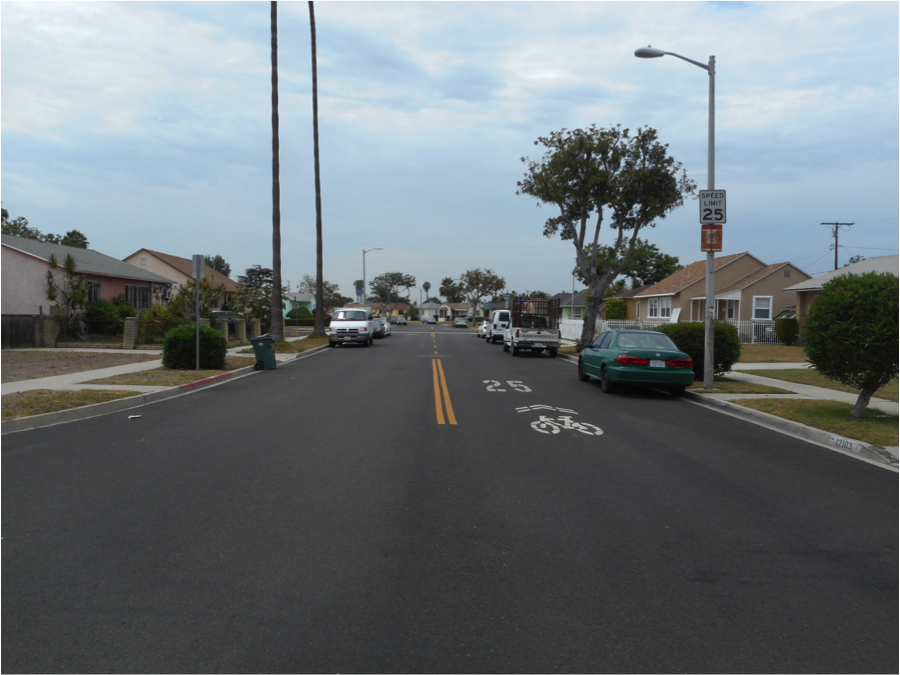
Moving forward, preparation began on the Transbarger Street project in a residential area of Rowland Heights, near the City of Los Angeles. This project included a three and a half mile portion of Transbarger. Both LA County and Ergon A&E expected ePrime to be the right solution to seal the micro fractured base and create a strong bond to facilitate the road paving and rehabilitation process. The Ergon A&E team was excited for the chance to display ePrime’s full potential in LA County.

Roadwork was set to begin in September of 2014, preparing the road base for treatment. Toro Enterprises, Inc., out of Oxnard, CA, was selected as the contractor, and Diversified Asphalt Products was the sub-contractor hired to administer the ePrime treatment. Ergon A&E had worked with this sub-contractor before; however, not in applying this particular product. Tom and Todd were present to provide any needed support to the crew.

Tom and Todd’s presence during the application process was helpful in allowing the sub-contractor to understand ePrime’s application process and suggest proper techniques for reaching optimal results. The product was produced and delivered from Ergon A&E’s Fontana, CA, emulsions plant site. ePrime was applied to the length of the roadway over a two-day period beginning April 20, 2015. During application, the weather temperature was in the mid 50s with cloudy, overcast skies.

Application of the ePrime began with a pre-wet surface and at a shot rate of 0.11 gallons per square yard. The cure time was 45 minutes. Within the hour, contractors began laying a 3” layer of CCPR asphalt concrete pavement to the roadbed followed by a thin overlay of Asphalt Rubber Hot Mix to complete the driving surface.

No Tracking
The crew was impressed that even immediately after application, ePrime did not track. ePrime is a quick-curing formula allowing roads to be pave-ready within a few short hours. Same-day paving is key when working in high-traffic or residential areas such as 124th and Transbarger streets.

Review

The Transbarger Street project was the first time the County got to see the full benefit of using ePrime from start to finish. They were again pleased with the stability ePrime provided during the construction phase, same as the 124th Street project, but were amazed at the ease of application and the lack of tracking after application. ePrime delivered on its promises, providing a protective moisture barrier for the base and creating a permanent bond between the base and subsequent asphalt layers to prevent slippage.

Long-Term Strategy

The process of stabilizing the roads in this area will be utilized over the next four to five years. With ePrime as their signature prime coat treatment in the road rehabilitation process, it ensures the improvements made can stand the test of time.

The success of ePrime is growing at a tremendous rate in California. LA County, along with other counties and national parks, now specify ePrime for their improvement projects. ePrime fills the need for environmentally compliant prime coats that are top-quality, user-friendly and get the job done right the first time.

ePrime asphalt base

Background

I-80; 8-Miles Between Park City, Utah, and Coalville, Utah (Summit County)

Interstate 80 (I-80) runs through the mountains in Summit County, Utah. It has seen heavy traffic for years, especially from large semi-trucks heading east toward Interstate 84. This traffic, along with harsh mountain weather, led to rutting and cracking along several sections of the interstate. These distresses forced UDOT to make continual repairs, and the rutting in particular made the winding mountain road unsafe for commuters. To restore it, UDOT decided to use Cement Treated Asphalt Base (CTAB) followed by Portland Cement Concrete Pavement (PCCP). Typically, a traditional prime coat would be used in between these two layers to help bond them together. However, traditional prime coats are expensive, slow to cure and are not environmentally friendly. For Geneva Rock Products, Inc., the contractor on this project, the challenge was to apply the CTAB and PCCP to both the east and westbound sides of the road in a timely manner, while causing as little inconvenience to traffic as possible and maintaining a safe environment. Ergon Asphalt & Emulsions suggested ePrime Eco-Friendly Prime Coat as a cost-effective and superior alternative to traditional primer due to its solvent-free properties and fast cure times.

eprime-2
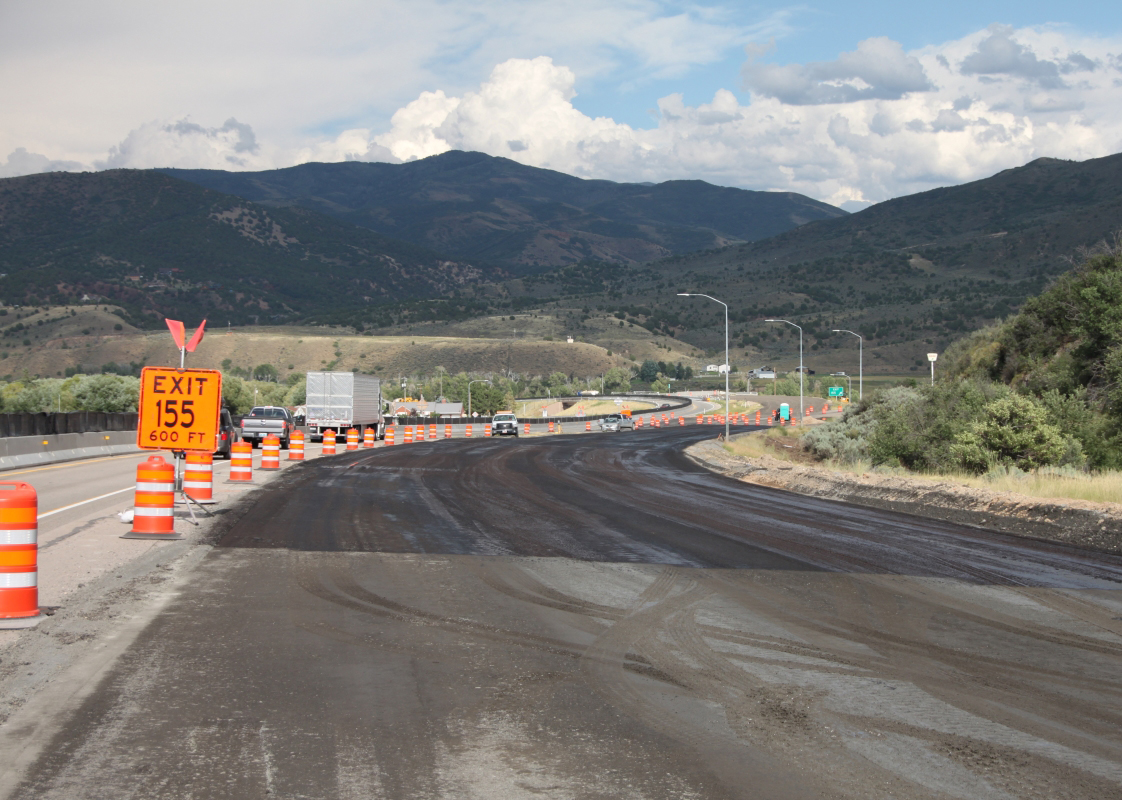
I-80 prior to the ePrime application.

Starting with the eastbound lanes, the plan was to lay 12 inches of PCCP atop the CTAB. Underneath the concrete, UDOT decided to use CTAB to reduce the cost of removing and replacing the existing base. The application of CTAB was the first of its kind along I-80. This decision was supported by research conducted by Lonnie Marchant, UDOT’s Region Two Materials Engineer, as well as Spencer Guthrie, a Brigham Young University Professor.

ePrime was key to the project’s success. The prime coat protected the pavement from weather and construction traffic for 7 days as the cement cured. The eco-friendly prime coat’s dust prohibiting properties would also prove beneficial, as it would improve safety and visibility with the heavy construction traffic.

Application Process

Cold mountain weather can cause chaos on roadways and is often a source of road cracking in Utah due to the many freeze/thaw cycles that occur during winter months. It can be an even bigger issue during road repair and preservation operations. Thankfully, weather conditions were mild throughout the entire first phase of the project aside from a few summer afternoon rainstorms.

Construction began on the eastbound side of the roadway, with traffic closures beginning July 2014 and lasting until December 2014. The process began with the milling of 5 inches of the existing pavement. Then, 4 additional inches were milled and mixed with 7% cement. These 9 inches made up the CTAB layer. ePrime was applied to the base at a shot rate of 0.15. It aided adhesion with the subsequent layer and protected the underlying layer from damage during this critical stage. Prior to paving the concrete overlay, ePrime protected the CTAB from being ripped open under heavy construction traffic. ePrime held up and also sealed the surface of the CTAB from moisture intrusion while providing a bonding layer. Finally, twelve inches of PCCP were placed on top, and ePrime promoted bonding with the CTAB layer. UDOT and Geneva Rock Products were pleased with ePrime’s performance, particularly that it upheld its reputation for providing a quick cure. They plan to continue using ePrime in future projects.

eprime-3
ePrime application on I-80.

Results

Overall, UDOT is very satisfied with this project. In addition to the CTAB, deficient super elevations were corrected, concrete barriers were updated and new drainage features were added, including reconstructed inlets, pipe replacements and new pipe liners. Also added were new wildlife escape ramps, signage and pavement markings. The entire process will be repeated on the westbound side, including replacement of the westbound bridge beginning in the spring of 2015.

Ergon A&E representatives were involved with the project since its inception. Area Sales Managers Greg Hunt of Las Vegas, NV, and Todd Vargason of Fontana, CA, came to Utah to offer their knowledge and expertise on the first day that ePrime was applied. Las Vegas Facility Manager Michael Holst had a large role in the production and shipping of materials to Salt Lake City, UT. Throughout the process, Ergon A&E’s North Salt Lake City, UT, Production Manager Brad Offinga and Facility Manager Tracy Bryan diluted and maintained the ePrime, while ensuring that the contractor had ample supply. Ergon A&E will continue to advise and assist Geneva Rock throughout the westbound phase of this project.