Ergon Inc.
Asphalt Emulsions Storage
Why are asphalt emulsion storage and handling requirements important?
Asphalt emulsions are a dispersion of fine droplets of asphalt cement in water. Since water is the carrier, medium specific storage and handling procedures should be followed.
What is the proper storage temperature for storing asphalt emulsions?
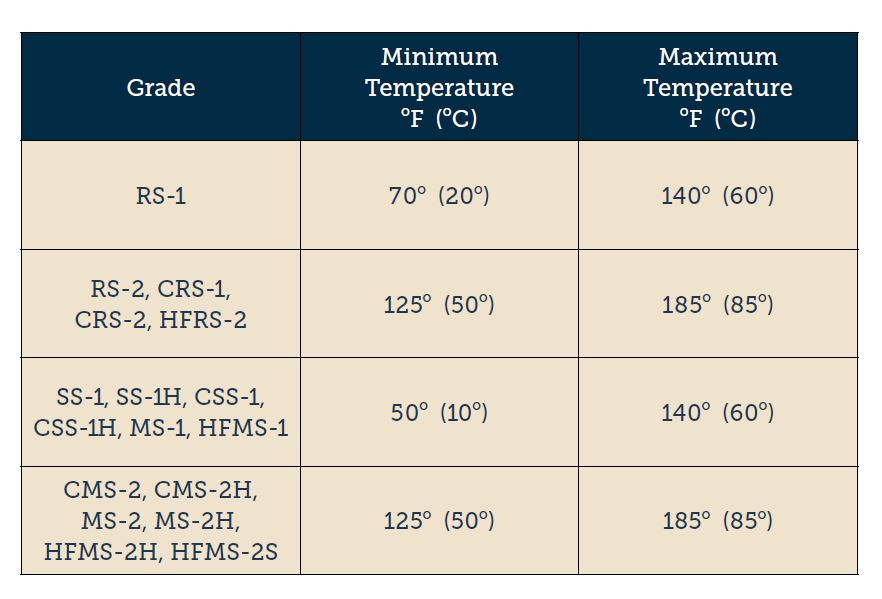
Store asphalt emulsion between 50°F (10°C) and 185°F (85°C). Do not permit the asphalt emulsion to be heated above 185°F (85°C). At elevated temperatures, the water will evaporate, changing the characteristics of the asphalt emulsion. The following chart outlines minimum and maximum temperatures for various grades of asphalt emulsion.
What will happen if the asphalt emulsion freezes?
This will break the asphalt emulsion, separating the asphalt from the water. The result will be two layers in the tank, neither of which will be suited for the intended use. Likewise, the tank will be difficult to empty.
What type of storage tank is best suited for storing asphalt emulsions?
Vertical storage tanks are best suited to store emulsions. Vertical tanks expose the least amount of surface area to air, thus reducing the formation of an asphalt skin on the surface of the emulsion. Tanks must also be insulated with a weather resistant covering to protect the asphalt emulsion from freezing and provide the most efficient use of heat. Additionally, side-entering propeller mixers can be used to gently agitate the asphalt emulsion. This eliminates any skin formation. Side entry mixer placement must be engineered to the size of the storage tank.
Can a pump be used to mix and circulate a storage tank of asphalt emulsions?
Yes. However, over-pumping is to be avoided since some asphalt emulsions are shear sensitive. Over-pumping and over-mixing can significantly alter the characteristics of the asphalt emulsion. Tanks should be circulated from top to bottom.
Can asphalt emulsions of different classes be mixed together?
Any amount of material remaining within a tank or tanker must be compatible with the added emulsion, and the amount remaining must be insufficient to cause the emulsion to fall out of specification. When asphalt emulsions of different classes are co-mingled in measurable quantities, the asphalt emulsion will become unstable and break. If in doubt, check with your asphalt emulsion supplier.